
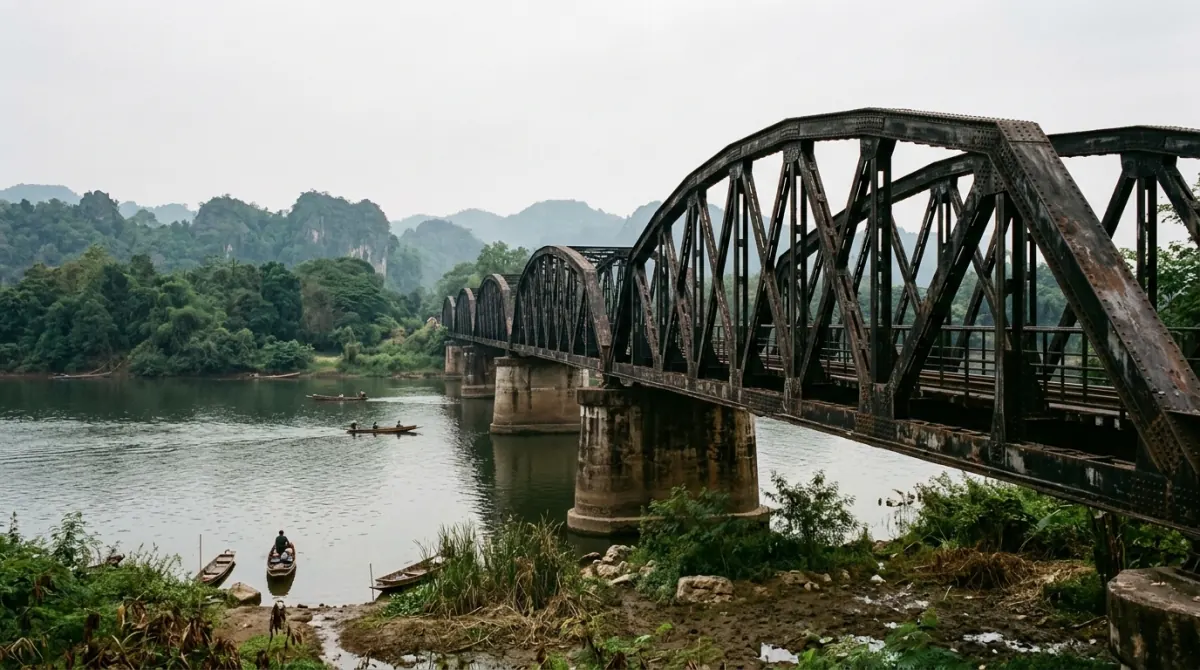
Between 12,000 and 13,000 Allied prisoners of war and 75,000 to 90,000 Asian labourers died building the Thailand-Burma Railway in 1942-43. The Bridge over the River Kwai is the famous site; Hellfire Pass, 80 km upriver, is the one worth building a day around, and entry there is free.
At a glance
| Site | Hours | Entry | From Kanchanaburi town |
|---|---|---|---|
| Bridge over the River Kwai | Open at all hours | Free | About 5 km north |
| Hellfire Pass Interpretive Centre | 09:00-16:00 daily, closed about three weeks each May | Free, no ticket; audio-guide deposit reported at 200 THB (about $6), refundable | About 80-85 km, roughly 1h20m |
| Thailand-Burma Railway Centre | 09:00-16:00 daily | Reported 160 THB (about $5) adult, 80 THB child 7-12 | About 1 km, facing the war cemetery |
| JEATH War Museum (Wat Chaichumphon) | Reported 08:30-16:30, unconfirmed | 30-50 THB (about $1-1.50), unconfirmed | In town, on the riverside |
| Kanchanaburi War Cemetery (Don Rak) | 08:00-17:00 Mon-Fri, 08:00-12:00 Sat; Sunday not published anywhere | Free | On Saeng Chuto Road in town |
| Chungkai War Cemetery | Open at all times | Free | About 5 km south-west |
| Tham Krasae / Wang Pho viaduct | Trackside, no gate | Free | On the railway, short of Nam Tok |
| Asian labourers (romusha) | No cemetery, register or memorial anywhere in the province | - | - |
Sixteen months on a five-year railway
The Japanese took Burma in early 1942 and then had to supply an army there. Doing it by sea meant the Strait of Malacca and the Andaman Sea, waters that Allied submarines and aircraft were making steadily more dangerous. A railway from Thailand across the hills into Burma removed that dependency. British engineers had surveyed roughly the same route before the war and set it aside as impractical. Japanese engineers put it at five years. It was finished in about sixteen months, and the way that was achieved is the whole story.
The line ran from Ban Pong in Thailand to Thanbyuzayat in Burma. Its length is given as 415 km by the Thailand-Burma Railway Centre, 424 km by the Commonwealth War Graves Commission and about 420 km by the Australian War Memorial, depending on where you measure from. Work began in June 1942, the two ends met in October 1943, and trains were running by December.
Two very different groups of people built it. About 60,000 Allied prisoners of war were put on the line: roughly 30,000 British, the largest single national contingent, more than 13,000 Australians, and large numbers of Dutch prisoners along with a smaller American group. Official sources publish national totals only for the British and Australians, so precise Dutch and American figures are hard to pin down.
Alongside them, and in far greater numbers, were about 200,000 romusha: Asian civilian labourers recruited under false promises or simply impressed. They came from Malaya, where a large proportion of them were Tamil, from Burma, from Java, and from Chinese communities across occupied South-East Asia. They had no officers, no camp organisation, no medical corps improvising quinine and no one keeping records of who they were.
Around 12,000 to 13,000 Allied prisoners died. The Australian War Memorial counts at least 2,815 Australians and over 11,000 other Allied prisoners by the railway's completion; the DVA says over 12,000 and puts it at one in five prisoners; the CWGC says approximately 13,000. They are compatible figures, not identical ones, and a range is the truthful way to state it.
The romusha death toll is estimated at 75,000 to 90,000, and the estimates are loose precisely because nobody counted. The DVA states that almost half of them died. That is roughly six times the number of Allied dead.
This is the fact that reorders the whole subject. The cemeteries you will visit in Kanchanaburi are beautiful, meticulous and Allied. The people who died in the largest numbers on this railway have no headstones, no register, no names on a wall and no annual service. Nearly every guide, sign and tour commentary in the province is built around the prisoners of war. Hold both halves in your head while you are here.
Today about 77 km of the line survives as a working passenger railway, running from Kanchanaburi to Nam Tok. Everything beyond that was lifted or has gone back to forest.
Treat the whole line as a burial ground
Almost everything in this chapter is a place where people were worked to death. Two of them are cemeteries holding more than eight and a half thousand graves between them, and the unmarked ground along the line is a burial site as well. The Allied graves were gathered into those two cemeteries after the war. The romusha dead were left where they were put, with no marker, no fence and nothing to tell you what you are standing on. The embankment you photograph the trestle from is that ground.
At the cemeteries, the ordinary CWGC conventions apply and they are not onerous: dress as you would for a church, keep your voice down, do not sit or stand on the headstones, do not move flowers or tributes left by families, and no picnics. Photographs of the site are fine. Posed photographs among the headstones are not, and neither is anything involving jumping, peace signs or a tripod set up in the middle of a row.
At Hellfire Pass, the cutting is where men died, and the memorial plaque at the bottom is the focus of an annual Anzac Day dawn service that drew about a thousand people in 2026. If you are visiting on 25 April, understand that you are attending a ceremony rather than a museum. On any other morning, the audio guide will tell you when you are standing somewhere specific; that is the moment to put the phone away for a minute.
At the bridge and on the trestle, the respect that matters most is for the train. Both carry scheduled services, and the staggered refuge bays built into the bridge deck exist because the alternative has killed people.
The bridge is real; the film is not
The bridge you walk across is a wartime structure, and almost nothing else about the popular story is accurate.
Start with the river. The bridge does not cross the Kwai. It crosses what was then the Mae Klong. David Lean's 1957 film, itself based on Pierre Boulle's 1952 novel, sent tourists to Kanchanaburi looking for a bridge on the River Kwai that did not exist, and in 1960 the authorities renamed the relevant stretch of the Mae Klong the Khwae Yai, or Big Khwae. The film was shot in Ceylon, now Sri Lanka.
The character of Colonel Nicholson, the British officer who ends up proudly building for his captors, is an invention that many survivors resented. The senior British officer at the bridge camp was Lieutenant Colonel Philip Toosey, who was no collaborator: he was beaten for protesting at the treatment of his men, and he did what he could to sabotage the work, including badly mixed concrete and termite-infested timber. Toosey's own comment on the film's central scene was that you could never have confronted the Japanese and made them lose face, and that had he done so he would not have survived.
The bridge itself is worth reading rather than just photographing. The Japanese built a temporary wooden bridge first, then a steel one assembled from spans shipped in from Java. Allied aircraft bombed it in 1945 and destroyed the middle. Look along the span: the curved, rounded trusses at each end are the original wartime steel, and the angular, straight-sided sections in the centre are post-war replacements. The join is visible from the riverbank in a way it is not from the deck.
You can walk the full length on planks laid along the track. Staggered semicircular refuge bays let you stand clear when a train comes. This is an operating railway with about three trains each way per day, restricted to 10 km/h over the bridge, sounding their horns the whole way. Tourists have been killed here.
Approximate crossing times are 06:14, 07:11, 10:42, 14:38, 16:33 and 17:30. At weekends the excursion train pauses at the bridge halt for roughly 20 to 30 minutes mid-morning before crossing at about 10:00, and comes back south at around 15:45 to 15:50, often late. These times come from specialist rail-guide sources rather than from the State Railway of Thailand, they vary by a few minutes between sources, and delays are routine. Treat them as a guide to when to be in position, not a schedule to rely on.
The bridge is busiest from roughly 10:00 to 16:00, when coaches arrive from Bangkok, and quietest around sunrise. That timing is reported by travel media rather than by any official body, so treat it as a strong pattern rather than a published fact. If you are staying overnight in town, walking out at first light is the single easiest improvement you can make to this visit: the same structure, the same river, and perhaps a dozen other people.
Tham Krasae and the Wang Pho viaduct
The wooden trestle at Tham Krasae is the piece of this railway that most looks like what it was. A curving viaduct of timber bents runs along a sheer limestone face with the Kwae Noi directly below, built by prisoners because there was no way to cut a shelf into the rock. Trains slow to cross it. The halt takes its name from the cave beside the track, tham being Thai for cave, which now holds a Buddha image and a small shrine.
It sits between Saphan Tham Krasae halt and Wang Pho station, well short of Hellfire Pass. Coming up from Bangkok or Kanchanaburi, sit on the left-hand side of the carriage for the view down to the river.
If you want to photograph a train on the trestle rather than ride across it, approximate crossing times are 05:57, 07:33, 11:47, 13:36, 16:09 and 17:47, plus 10:52 and 14:55 at weekends only. The same caveat applies as at the bridge: these come from a rail-enthusiast source, not the railway operator, and they move.
Should you ride the train to Nam Tok?
Ride it once, and ride it on the first train of the day. The line is slow, hard-seated and worth it for two stretches — the bridge and the Wang Pho trestle — and everything either side of those is ordinary countryside.
Departures from Kanchanaburi towards Nam Tok are around 06:02, 10:30 and 16:21 daily, plus 09:38 at weekends and public holidays. Coming back, trains leave Nam Tok at about 05:20, 13:00 and 15:30, with an extra 14:25 at weekends. The 15:30 goes only as far as Kanchanaburi and does not continue to Bangkok. Journey time between Kanchanaburi and Nam Tok is roughly 1h35m to 2h. Fares, ticketing and the Bangkok end of the line are covered in Getting to Kanchanaburi from Bangkok and the Airports.
Leaving Kanchanaburi at about 06:02 puts you over the trestle around 07:35 in soft light and into Nam Tok by 08:00, which lines up with Hellfire Pass opening at 09:00 if you can arrange the last 18 km from the station. That leg is the weak link, and it is dealt with under Hellfire Pass below. The 10:30 does the opposite: harsh overhead light on the viaduct and the bridge at its most crowded.
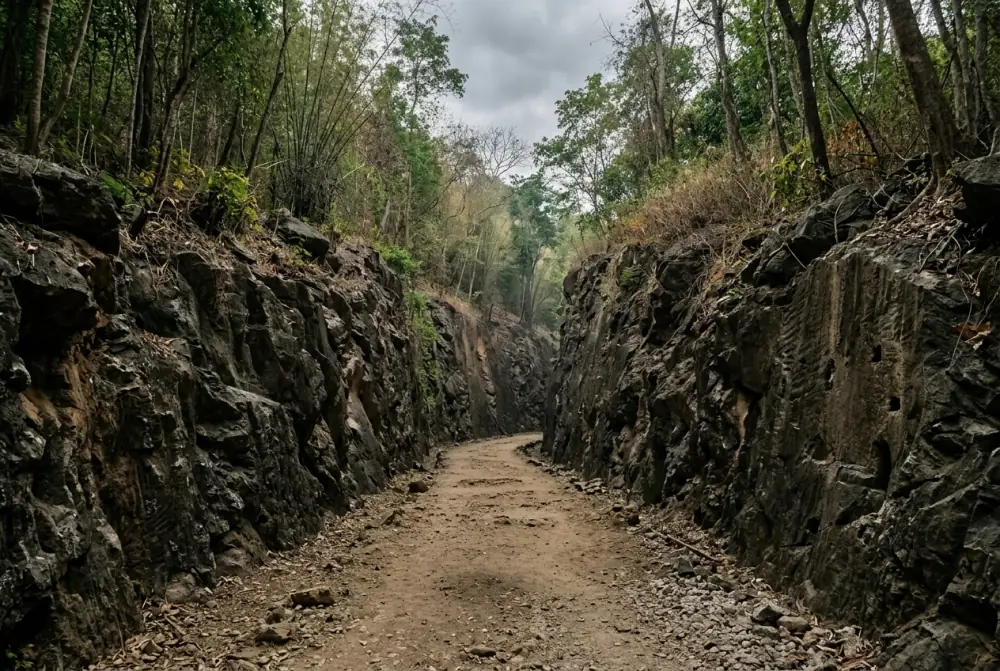
Hellfire Pass
Most one-day tours from Bangkok do the bridge, a cemetery, a museum and a short train ride, then turn around. Hellfire Pass is 80 to 85 km north-west of Kanchanaburi town, about an hour and twenty minutes each way on Highway 323, and that round trip is what gets cut. It is the wrong thing to cut.
Its proper name is the Hellfire Pass Interpretive Centre and Memorial Walking Trail. It is not a Thai national museum: it is an Australian Government facility, built and run by the Department of Veterans' Affairs, at 207 Moo 11, Tha Sao, Sai Yok District. That matters practically, because it explains why the standard is what it is, why there is no ticket, and where to check its status before you drive out.
Entry is free. There is no admission charge and no ticket for either the centre or the trail. The audio guide is free too, against a refundable deposit for the handset, returned when you hand it back. That deposit is reported at 200 THB by travel sources rather than published on the DVA's own pages, so carry a little more than that in cash and expect the desk to be the final word.
The narration is in English with historical notes in Thai, Dutch and Japanese, and it is triggered at points along the trail: bamboo, the rail bed, the cutting, the broken drill bit, medical, cholera. Much of it is survivors speaking. Take it. The cutting without the audio is a rock corridor; with it, it is a place where specific named men worked eighteen-hour shifts by torchlight.
The name comes from what the site looked like at night, when prisoners cutting Konyu Cutting by carbide lamp and open fire were said to resemble a scene from hell. The work was done with hammer and tap: one man holding a drill steel, another swinging an eight-pound hammer, then explosives, then baskets. The rock was cut by hand.
There are two walks. The short one, down to the Konyu and Hellfire Pass cuttings and the memorial plaque, takes roughly 40 to 45 minutes return. The long one, out along the original rail bed past the Kwae Noi valley lookout, the Hintok station site, Hammer and Tap Cutting, the Three-Tier Bridge site, Pack of Cards Bridge and on to Compressor Cutting, takes about three hours return. Published distances for the long trail disagree — the DVA's Thai-language site says 2.5 km while several travel sources say around 4 km each way — so plan on the DVA's times, which are consistent, rather than on a kilometre figure.
The short walk involves a long flight of steps down into the cutting and the same flight back up. There is shade in the cutting itself and very little on the long trail. In the hot months this is a real consideration, and the centre closes at 16:00.
If you are relying on public transport, buses running north up Highway 323 towards Sangkhlaburi stop at Hellfire Pass, and leave Kanchanaburi roughly every half hour from about 06:00. That works, though it commits you to whatever the return bus does: they are flagged down from the roadside rather than boarded at a stand, and you want to be out there well before the 16:00 close rather than at it.
The 18 km between Nam Tok station and Hellfire Pass is the leg nobody has solved for you, and it is the one that breaks train-plus-pass days. No source publishes a songthaew or motorbike-taxi fare for that hop, the northbound buses run along Highway 323 rather than through the station forecourt, and there is nothing at the pass but the centre, so do not count on finding a driver waiting there for the return. If you are arriving by train, either agree a price and a pick-up time with a driver at Nam Tok before you set off, both ways, or have the pass reached by road and use the train for the bridge-to-trestle stretch only.
One development worth knowing about: as of July 2026 the provincial administration is pushing to have the bridge and the Death Railway registered as a UNESCO World Heritage site, and the State Railway of Thailand has been reported as developing a rail extension towards a Hellfire Pass station. The heritage bid is stalled between ministries and nothing has been built. Do not plan around either.
The Thailand-Burma Railway Centre earns your hour; JEATH mostly does not
If you have time for one museum in town, make it the Thailand-Burma Railway Centre.
It opened in 2003, after years of field survey of the entire route on the ground, and it shows. It is organised as a museum, information point and research facility covering the full 415 km rather than as a collection of relics, it is air-conditioned, the captions are written for people who do not already know the story, and part of its income funds a database of Allied prisoners who died in the Asia-Pacific. Admission is reported at 160 THB for adults and 80 THB for children aged 7 to 12, open daily 09:00-16:00. Those fees come from secondary sources rather than from the centre's own fee page, so take them as the order of magnitude and confirm at the door. It sits at 73 Chao Khun Nen Road, directly facing the main war cemetery, which makes the obvious pairing: museum first for an hour, then the cemetery across the road with the names now attached to something.
The JEATH War Museum is a different proposition. It was founded in 1977 by the abbot of Wat Chaichumphon, on the river in central Kanchanaburi, and it was the first Death Railway memorial museum anywhere. Its centrepiece is a reconstruction of a bamboo prisoners' hut, and the acronym stands for the nationalities involved: Japan, England, Australia and America, Thailand and Holland. That founding role matters. So does what the acronym leaves out: it names six combatant nations and no Asian labourers, which is the omission this chapter is about.
The museum itself has not kept pace. Visitors consistently report dust-covered photographs, sun-bleached captions that are hard to read, and general disrepair, and specialist sources agree it has been overtaken by both the Railway Centre and Hellfire Pass. It costs very little and it will not take long. Go if you have a spare half hour and an interest in how this history was first memorialised in Thailand; skip it without guilt if your time is short.
Its admission fee and opening hours are the least reliable numbers in this chapter. There is no official museum website. Sources give the entry fee as 30 THB or 50 THB, and the hours as 08:30-16:30 or 08:30-18:00. Budget a small note, turn up mid-morning, and expect to be corrected at the door.
That second museum, the one by the bridge, announced around Songkran 2025 that it was closing because of financial difficulties, and a sign seen at the site in May 2025 said it was in its last year. Whether it has shut is not confirmed; some 2026 listings still show it as operating. Do not build a plan around it either way, and do not let the story worry you about the temple museum, which is a separate institution with no reported closure.
The two cemeteries
Kanchanaburi War Cemetery, known locally as Don Rak, holds 6,982 graves. The Commonwealth War Graves Commission breakdown is 3,569 United Kingdom, 1,896 Netherlands, 1,362 Australia, 12 India, 2 New Zealand, 1 Canada, 139 unidentified Commonwealth and one non-war grave. It was made after the war by the Army Graves Service, which concentrated into it the burials from the whole southern section of the line, from Bangkok up to Nieke. It is on Saeng Chuto Road in the middle of town, open 08:00-17:00 Monday to Friday and 08:00-12:00 on Saturday, free, with a large level car park. The cemetery register is kept at the site office. Step-free access is through the service entrance beside the office building.
Those hours need a caveat, because two itineraries in this guide are built on them. They come from secondary listings; the CWGC's own visiting page for Kanchanaburi could not be read, and no source publishes Sunday hours at all. Nobody appears to have written down whether Don Rak opens on a Sunday. If Sunday is the day you have, go to Chungkai instead, which is open at all times, and treat Don Rak as a bonus if you find the gate open. Neither cemetery charges: CWGC sites never do.
Beside the graves, the Kanchanaburi Memorial records eleven names: men of the undivided Indian Army, from India, Nepal and Pakistan, who were buried in Muslim cemeteries where the graves could not be maintained.
Chungkai War Cemetery is smaller, quieter and in some ways more affecting. It holds 1,739 graves: 1,371 United Kingdom, 313 Netherlands, 6 India and 49 unidentified Commonwealth. What distinguishes it is its origin. It was not laid out by a graves service after the war. It was started by the prisoners themselves, at a base camp that had a hospital and a church, and it stands on the ground where those men were buried by their friends. It is about 5 km south-west of town where the river divides into the Mae Khlong and the Kwae Noi, reached over the narrow Sudjai Bridge or by boat. It is open at all times, free, with a ramped service entrance to the left of the main gate.
Both are owned and maintained by the CWGC, and the standard of upkeep is unmistakable the moment you walk in.
Then walk out and remember what is not there. Roughly 75,000 to 90,000 romusha died on this railway, six times the Allied toll, and the CWGC commemorates Allied dead only. There is no equivalent cemetery, no register, no roll of names. In some places along the line their remains are simply in the embankment. The immaculate rows in Don Rak are a record of who was counted, not of who died.