
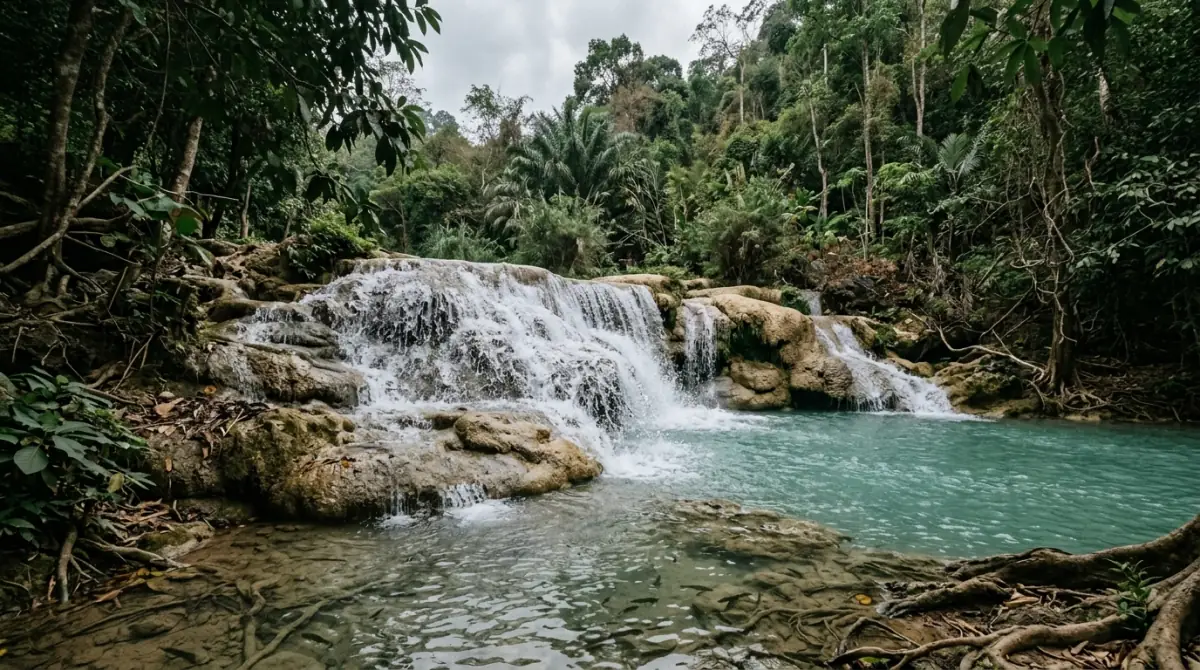
Erawan Falls is the waterfall to do: seven tiers, 300 THB to enter, open 08:00–16:30 with no entry after 15:30. Swimming was suspended in September 2025 and no source confirms it has resumed — ask at the gate. Most visitors stop at tier 2; tiers 5 to 7 are a rock scramble. Best water: late November to January.
At a glance
| Site | From Kanchanaburi town | Foreigner entry | Hours | Water in the dry months |
|---|---|---|---|---|
| Erawan Falls (Erawan National Park) | 65–75 km, about 1h 15m | 300 THB adult (approx. USD 9), 150 THB child 3–14 (approx. USD 4.60) | 08:00–16:30 daily, no entry after 15:30 | Tiers 1–4 hold water; 6 and 7 thin badly |
| Huay Mae Khamin (Khuean Srinagarindra / Sri Nakarin National Park) | about 110 km, 2.5–3 hours | 300 THB adult, 150 THB child | 08:00–16:30 daily | Middle tiers have dried out completely in a bad year |
| Sai Yok Yai (Sai Yok National Park) | 100–113 km depending on source, about 2 hours | 300 THB adult, 150 THB child | 08:00–16:30 daily | Falls straight into the river, so there is always something |
| Sai Yok Noi | about 60 km, about 1 hour | Free, no gate | Roadside, daylight | A wet rock in March and April |
| Lawa Cave (Sai Yok National Park) | about 75 km, then a long-tail boat | Covered by the Sai Yok park ticket | Reported as 08:00–16:30 or 09:00–16:00 | Not weather-dependent |
Vehicle fee at all three national parks: 30 THB per car (approx. USD 0.90), 20 THB per motorbike (approx. USD 0.60). Thai nationals pay 60 THB adult and 30 THB child at the same gates. Bring cash — whether any of these gates now take cards is not something the parks publish.
Swimming at Erawan may not be open. The park suspended all swimming on 16 September 2025, after rain pushed water levels and currents up — reported by Nation Thailand on 17 September 2025, which is the last word anyone has published on it. No source confirms the suspension has been lifted, and the park does not post its status anywhere a visitor can check from home. When swimming is open it is allowed at tiers 1 to 5 and at tier 7. Ask at the gate, or at the tier 2 checkpoint, before you change: staff there know what today's rule is, and the water can look calm on a day the pools are shut. Plan a day that works either way — the walk, the tiers and the views do not depend on getting in.
Erawan tier by tier
Erawan is not one waterfall but a 1.5 km staircase of them, and the difficulty is concentrated in the top third. From the car park it is about 500 m of flat paved path to tier 1 — roughly ten minutes, or a short ride on the park's golf cart if one is running. Sources quote the shuttle at 10, 20 and 30 THB, so carry small notes and expect to be told the price at the cart.
| Tier | Thai name | From the car park | What it is |
|---|---|---|---|
| 1 | Hlai Khuen Rang | 500 m | Wide, shallow, busiest, visually the least interesting. Toilets and life jackets here. |
| 2 | Wang Macha | 600 m | The deep turquoise pool from every photograph. Last toilets, showers and changing rooms. The checkpoint tier. |
| 3 | Pha Nam Tok | 700 m | A tall curtain of water with a shaded pool about 2–2.5 m deep; when the pools are open you can swim in behind the fall. |
| 4 | Ok Nang Phi Suea | 1,050 m | The natural limestone slide, and the best all-round swimming when the pools are open. Crowds thin sharply from here. |
| 5 | Buea Mai Long | 1,550 m | The longest single climb, 450–600 m of it. A run of shallow stepped pools. |
| 6 | Dong Phruksa | 1,750 m | Green and quiet, and the weakest flow of the seven outside the rainy months. |
| 7 | Phu Pha Erawan | 2,000 m | The tallest and most layered fall, with two small pools and a sign at the top reading "You are the conqueror". |
Those distances are the figures repeated across guides and appear to come from park signage, but a second dataset circulates that measures from tier 1 rather than the car park, which is why you will see the falls described as 1,500 m long, 2,000 m long and — on the national park department's own page — 2,200 m. They reconcile: about 500 m of approach, then about 1,500 m of waterfall.
Most visitors go no further than tier 2. That is where the deep pool is, where the toilets are, and where the coach groups stop, and on a busy morning it can hold a hundred people. Tier 3 is four minutes further and much emptier. Above tier 4 the crowd falls away almost entirely.
The concrete and the handrails run out somewhere around tier 3 or 4 — accounts vary, and at least one source says a stretch of the upper path has recently been concreted while a 2019 Thai news report had the park explicitly refusing to pave it because visitors preferred the natural surface. Take the practical version: from tier 4 upward you are on wet rock, tree roots, and short lengths of wooden boardwalk, climbing steadily. Tier 5 is the long grind. The last pitch to tier 7 is roughly 200 steps and about six minutes of hands-on climbing, and it is the section where people turn back.
Footwear decides how far you get. Flip-flops are the common mistake and they fail on wet limestone. What works is a sandal with a heel strap and a grippy sole, a proper water shoe, or trainers you have accepted will be soaked. Whatever you wear will get wet, because the trail crosses the stream repeatedly and the rock stays damp even in dry weather. Barefoot is worse than either — the limestone is sharp where it is not slick.
The fish are not spa fish. English write-ups routinely call them Garra rufa, the fingernail-sized "doctor fish" of foot-tanks. The fish in the Erawan pools are pla phluang, a mahseer barb identified in photographs from tiers 1 and 2 as Neolissochilus stracheyi — a carp, and a substantial one. Grown fish are hand-sized and larger, they arrive in numbers the moment you stand still in tier 2, and the contact is a firm bump rather than a tickle. Children either love it or get out fast. Nobody is being harmed by it, but it is worth knowing before a shoal of them closes in on your legs.
Allow three to four hours at the falls. Walking without stopping, tier 7 is 45 to 60 minutes up; with swims and photographs, 1.5 to 3 hours is realistic, and 25 to 60 minutes back down. The round trip is roughly 4 km with a little over 200 m of ascent — the 229 m you will see quoted comes from hikers' GPS logs, not from a park measurement, so treat it as the right order of magnitude rather than a survey.
The gate closes at 16:30
Erawan opens at 08:00 and the gate closes at 16:30, every day of the year. Two Thai-language sources give an earlier opening of 07:00 or 07:30, and the national park department's own page lists only the shop hours, so treat 08:00 as the safe assumption and take an earlier opening as a bonus. One source states there is no admission after 15:30; no other source corroborates it, but it is consistent with everything else about the afternoon.
The park does not publish a single cut-off for the upper tiers, and the sources disagree. Rangers are described as starting to sweep down from tier 7 at about 15:00. Most English accounts and one Thai source say upper access closes at 15:30; two Thai sources phrase it as no ascent to tiers 3 to 7 after 16:00. The behaviour is more reliable than the number: if you want tier 7, be walking up from the visitor centre by 14:00 at the very latest, and ideally hours earlier.
Arriving before 10:00 changes three things at once. The Bangkok day-trip coaches and the minibuses reach the park mid-morning and they all stop at tier 2, so an early start means you are above them rather than in them. The climb is hot after 11:00 and the upper trail has no breeze. And you get the whole afternoon as slack, which is what you need if you decide at tier 5 that you do want tier 7 after all.
Car-free visitors have a harder version of this problem. Bus 8170 does run from Kanchanaburi bus station to the park — the first one of the day puts you at the gate around 09:30, and the last bus back leaves at 16:30, so the bus day is fixed at both ends and misses the quiet first ninety minutes; fares and the full timetable are in the getting-there chapter. How the falls fit into a one- or two-day trip is covered in the itineraries chapter.
What 300 baht buys, and the two rules enforced at tier 2
Foreign adults pay 300 THB and children aged 3 to 14 pay 150 THB, plus 30 THB for a car or 20 THB for a motorbike. Thai nationals pay 60 THB and 30 THB. If you find a guide quoting 100 THB for Thai adults or 200 THB for a foreign child, it is out of date: the national park department reduced these fees on 7 June 2022, and Erawan, Sai Yok and Sri Nakarin all sit in the resulting 300/150 band. Erawan was not among the five parks later raised to 400 THB. The 300/150 band is what visitors report paying now; the June 2022 date and the reduction itself come from secondary summaries rather than the department's own fee notice, so take the price as current and the history as reported.
Two rules bite at the tier 2 checkpoint, and both are enforced by staff who check bags.
The bottle deposit. Every plastic drinks bottle you carry above the checkpoint costs a 20 THB refundable deposit. The bottle is marked, and you get the 20 THB back when you come down and show the empty. It exists because the upper trail used to be littered, and it works. The practical consequence is to carry one bottle rather than four, and to stop on the way out and reclaim the deposit, which plenty of people forget. Most accounts put the checkpoint at tier 2, though a few place it at tier 1 or tier 3, so have the cash ready from tier 1 onward. No source addresses whether a refillable bottle is treated the same way.
No food above tier 2. Eating is confined to tiers 1 and 2, where there are shops and tables. Bags are inspected and food is left behind, not confiscated politely and returned. Alcohol and glass containers are banned throughout the falls, and pets are banned from the park entirely.
When swimming is open, life jackets rent at tier 1 for 20 THB, reported as covering two hours with 10 THB per extra hour, and are also available at tier 3. Several sources state a life jacket is required to swim; the park does not publish that as a rule, so it may be a tier-specific instruction or a ranger's discretion rather than a blanket requirement.
Where you can swim, if you can swim at all. Start from the suspension above: all swimming was stopped on 16 September 2025 and nothing published since says it has been lifted, so the tier list below is what applies on a day the pools are open, not a promise about the day you arrive. Confirm at the gate or the tier 2 checkpoint. Swimming is allowed at tiers 1 to 5 and at 7. Tier 2 is the deepest, tier 3 lets you get behind the water, and tier 4 has the rock slide. Several independent visitor accounts report that swimming is not permitted at tier 6 and that a ranger is posted to enforce it, but no official Thai-language or department source confirms this — assume it is in force and ask if it matters to you.
Huay Mae Khamin trades a day of driving for an empty waterfall
Huay Mae Khamin is a seven-tier waterfall in Khuean Srinagarindra National Park, about 110 km from Kanchanaburi town — roughly 45 km beyond the Erawan turn-off, along the Sri Nakarin reservoir. The fee structure is identical to Erawan: 300 THB adult, 150 THB child, 30 THB per car.
The drive is what decides it. You take Highway 3199 north as if going to Erawan, turn left about 1.5 km past the falls, and follow the reservoir road for the last 45 km. That road is now paved end to end and signposted in English, but it runs single-file in places, climbs and drops through blind bends above the water, and has broken edges and potholes, and the final 45 km alone takes about an hour. Two hours is the fast version and not the figure to plan on; 2.5 to 3 hours each way is what most people experience. There is no scheduled bus or songthaew of any kind to the falls, and the nearest public transport terminates at Erawan, over an hour short. It is a poor road for a low-clearance rental car and a worse one for a scooter.
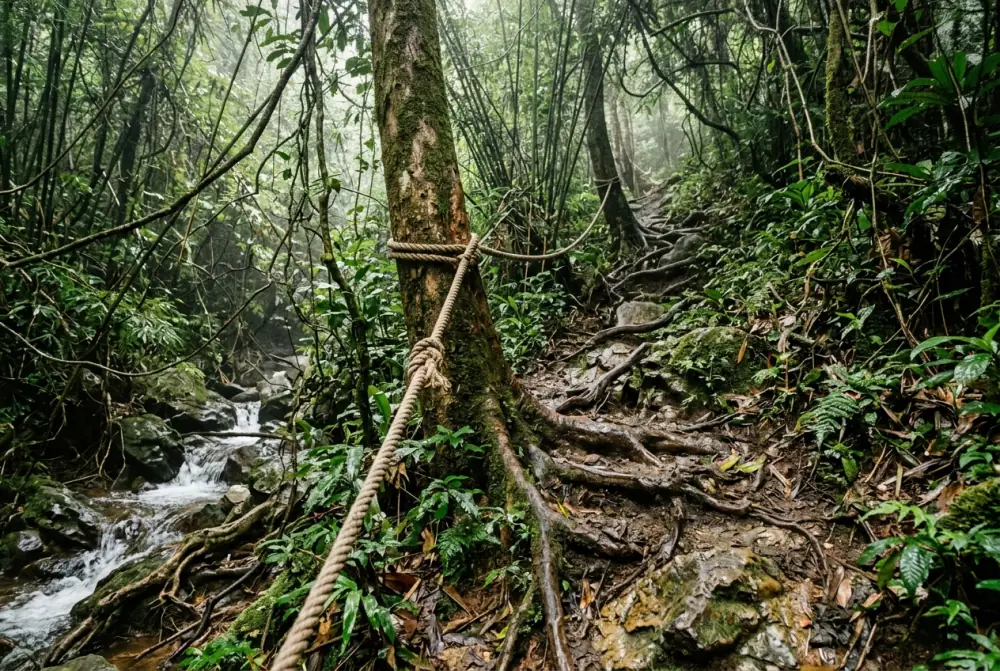
The waterfall itself is easier than Erawan, not harder: about 2 to 2.3 km of trail with roughly 195 to 275 m of climb, with boardwalk, stairs and handrails on the lower section through tier 3 and an unpaved, muddy path above. Tiers 1 to 4 are all within about 750 m. Tiers 5 to 7 add over a kilometre. Swimming is allowed in most of the pools. The seven tiers are Dong Wan, Man Khamin, Wang Na Pha, Chat Kaeo, Lai Chon Long, Dong Phi Suea and Rom Klao.
The verdict: go only if you have a vehicle, a full day, and water in the system. The water at Huay Mae Khamin is not more impressive than Erawan's — the difference is that you may have a tier entirely to yourself, which at Erawan happens only above tier 5 and only early. On a first two-day Kanchanaburi trip it is the wrong choice, because you spend four to five hours in a car to see something Erawan already gave you with less effort. In March or April it is close to pointless: in early February 2016, according to contemporary Thai press reports, tiers 3, 4 and 5 dried up completely for about half a month, and the park director was quoted saying it had never happened in his time there. And do not try to pair it with Erawan in one day. Two national parks and 200 km of provincial road is a driving day with waterfalls attached.
If you want it, the practical shape is a full-day charter that leaves town before 07:00, which is a custom arrangement rather than a scheduled service (contact).
Is Sai Yok Yai worth the drive?
Sai Yok Yai and Sai Yok Noi are two different places 38 to 40 km apart, and people conflate them constantly.
Sai Yok Yai is inside Sai Yok National Park, roughly 100 km from town up Highway 323, then about 3 km off the highway to the visitor centre. Its distinguishing feature is not size — it is a fall of perhaps 8 to 10 metres, a figure that comes from a single source and is not published by the park — but where it lands. The water tips off a limestone bank directly into the Kwai Noi rather than into a pool, beside a suspension footbridge next to the visitor centre. Rama V bathed here, which is most of its fame. Several sources warn that its reputation online is inflated, and that is fair: if you drive two hours expecting an Erawan, you will be disappointed within ninety seconds. Go for the river setting, the footbridge and the floating restaurants, which are covered properly in the River Kwai chapter. Flow is best from about June or July onward.
Sai Yok Noi, also called Khao Phang, is free. It sits directly on Highway 323 with no turn-off and no gate, about 60 km from town and 1.5 to 2 km from Nam Tok railway station at the end of the Death Railway line — which is why weekend excursion train passengers pour into it and why it is far busier than Sai Yok Yai. It is taller and more conventionally waterfall-shaped than its bigger-named neighbour, a multi-level limestone cascade with a splash pool at the base you can reach without climbing anything. There are food stalls, souvenir shops, a coffee shop above the falls and a campground.
Its seasonality is severe. Sai Yok Noi is worth stopping for from June to October and best in October after sustained rain. In March and April it is a damp streak on limestone with a shallow pool at the bottom. The case for it is narrow and sound: it is free, it is directly on the road to Hellfire Pass and the railway terminus covered in the Death Railway chapter, and it costs twenty minutes. Nobody should drive out from town for it alone.
Lawa Cave is the main cave in Sai Yok National Park, at Wang Krachae about 75 km from town. Highway 323 runs along the far bank, so the usual approach is a long-tail boat from Pak Saeng pier, about 45 minutes each way; Lonely Planet quotes roughly 1,200 THB (approx. USD 37) for the boat return, though boat prices in Kanchanaburi move and are negotiated at the pier. There is also a road approach over a bridge near the railway station about 20 km south. Your Sai Yok park ticket covers it. The cave is reported at 530 m in total with a 17 m vertical range, of which the self-guided visitor route is 280 m through three named chambers — Music, Throne and Curtain; those measurements circulate identically across guidebooks and aggregators and read back to a single source. It is electrically lit but dimly, so bring a torch, and the connections between chambers require stooping. There are large bat colonies. Opening hours are given as 08:00–16:30 by some sources and 09:00–16:00 by others.
Daowadung Cave, also in Sai Yok National Park and also on the same ticket, is reported at 240 m long and reached by road or by a 6 km long-tail trip followed by a 1.5 km uphill walk from the ranger station. That approach is the verdict: it is a small cave at the end of a boat ride and a climb, and it is not worth a first or second visit to the province.
For most visitors the boat ride is the experience at Lawa and the cave is the excuse. If your day is already carrying Hellfire Pass and a waterfall, drop the caves rather than compressing everything.
The falls never close for the season — but three months barely run
This is the point most guides get backwards. The national park department's 2026 closure schedule — signed 18 December 2025 and published in the Royal Gazette on 9 January 2026, effective from 1 January — lists no seasonal closure at all for Erawan. Those citation details come from reporting of the announcement rather than from the Gazette entry itself, so confirm them if you are relying on the schedule for a specific date. For Sri Nakarin it closes only the Zone 5 bungalows at the Pha Tad ranger station, and for Sai Yok only the Zone 1 bungalows at park headquarters, both indefinitely. Huay Mae Khamin, Sai Yok Yai and Sai Yok Noi are not on the list. The Kanchanaburi sites that do shut for months are elsewhere: Khao Chang Phueak in Thong Pha Phum (1 February–31 October), San Nok Wua in Khao Laem (16 February–30 September), the Khao Kamphaeng trail in Chaloem Rattanakosin (1 February–17 October) and several caves and campsites in Lam Khlong Ngu.
So the waterfalls are open every day of the year. Whether there is water in them is a different question.
| Months | Flow | What you get |
|---|---|---|
| Late November – January | High and falling slowly | The best window. Water has cleared to the milky turquoise of the photographs and the upper tiers are open. |
| February | Declining, still clear | A fair compromise. Visibly less water than January but the colour holds. |
| March | Weak | Tier 6 and the upper reaches of Huay Mae Khamin thin out. |
| April | Weakest | The month to avoid. Upper tiers can be trickles, and a smoke closure of the kind Erawan had in April 2026 is a live risk. |
| May | Rising, not yet arrived | Rain has started but the falls have not caught up. Improving through the month. |
| June – August | Rebuilding | Respectable rather than spectacular, green, and much quieter than high season. |
| September – October | Maximum | The most water of the year — and silty and brown rather than turquoise, with muddy trails and the upper tiers most likely to be pulled for safety. |
| November | High and clearing | Arguably the single best month: flow still strong, the water turning clear. |
The lag is the thing to understand. The rain and the falls are six to ten weeks out of step: flow peaks in September and October, but the water only looks its best once the catchment has stopped washing sediment down and before the level runs out from under it. Month-by-month rainfall, temperature and the haze season are in the practical chapter.