
Kanchanaburi is hot in all twelve months, and April averages about 37°C — heat is what hurts visitors here, along with wet rock and unlit roads. Eat at the night market by the train station, not the riverside strip. Sleep in town to walk to dinner. Carry cash; machines thin out north of town.
At a glance
| Best months overall | Late November to February — dry, days 31–34°C, nights 21–23°C |
| Hottest month | April: average daily high about 37°C, nights above 25°C, UV index 11+ |
| Wettest month | September: roughly 180–203 mm across about 18 rain days |
| Annual rainfall | About 1,112 mm, spread over a wet season of roughly early May to late October |
| Budget guesthouse, fan room | 300–500 THB (about USD 9–15) per night |
| Guesthouse, air-conditioned | 600–900 THB (about USD 18–27) |
| Mid-range hotel or bungalow | 800–1,500 THB (about USD 24–45) |
| River resort in or near town | 1,200–2,000 THB (about USD 36–60) |
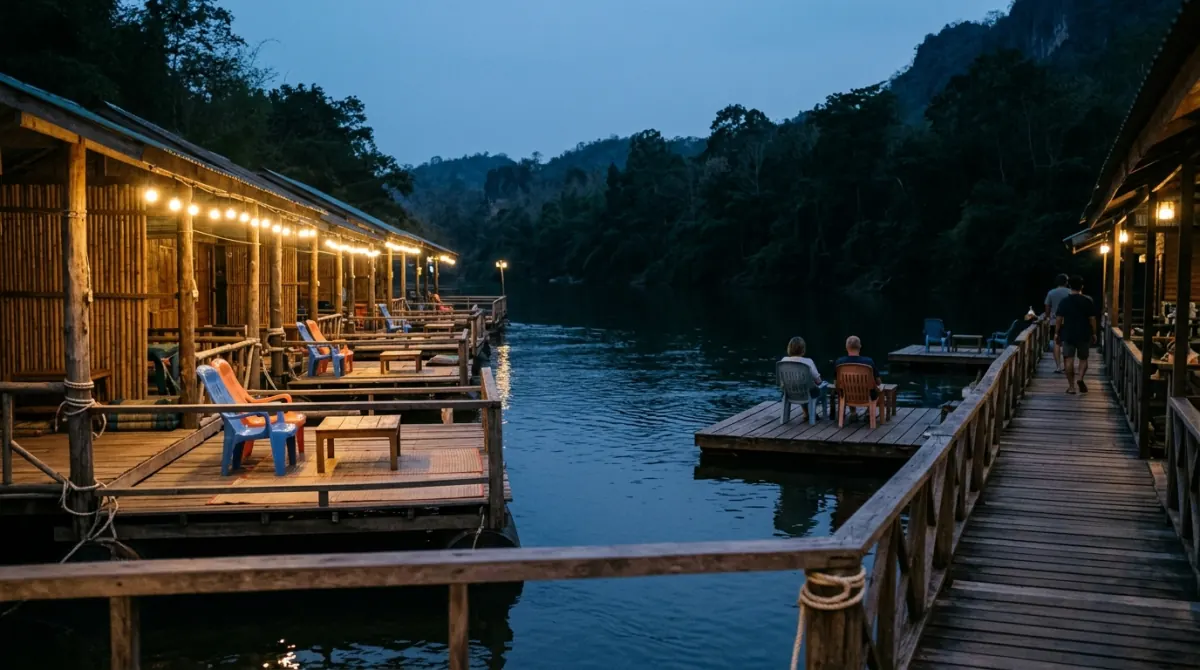
| Floating room at a town guesthouse | 400–1,200 THB (about USD 12–36) |
| Where those five bands come from | One 2026 aggregator roundup, not rack rates — the shape of the market rather than quotes |
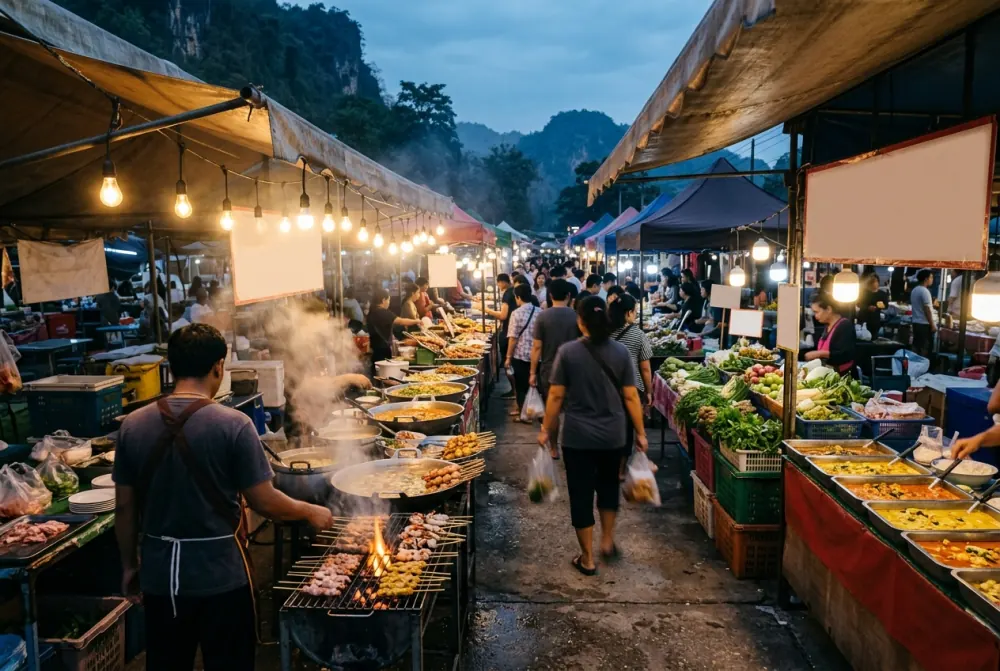
| Night market | Beside the main train station, daily from about 17:00, cash only |
| Foreign-card ATM surcharge | 220 THB (about USD 6.70) per withdrawal at most machines, more at some |
| Main hospital | Phaholpolpayuhasena, Saeng Chuto Road, government, 24 hours |
| Emergency numbers | Ambulance 1669 · Police 191 · Fire 199 · Tourist police 1155 |
| Malaria status | Very low risk province-wide; bite avoidance rather than tablets |
| Dress code | Shoulders and knees covered at temples and at both war cemeteries |
Where should you sleep in Kanchanaburi?
Kanchanaburi's accommodation divides into three bases that are not interchangeable, and the choice mostly decides what time your days can start and where you eat.
Read every room rate in this chapter as the shape of the market rather than as a quote. All of them trace to a single 2026 aggregator roundup rather than to property rack rates, including the named floating-room prices further down, and Thai room rates move with the season, the festival calendar and the day of the week. Use the bands to work out which tier you are shopping in, then get a price from the property or a booking site for your dates.
The riverside guesthouse strip is the default and the right answer for most first visits. It runs along Mae Nam Khwae Road and the parallel Song Kwae Road on the town side of the river, and it holds nearly all the cheap rooms, most of the bars, the tour desks and the bicycle and motorbike shops. Fan rooms with a shared or basic private bathroom run 300–500 THB a night. Air conditioning takes you to 600–900 THB, and 800–1,500 THB buys a proper mid-range bungalow or a small hotel room with a fridge, hot water and breakfast. The strip is walkable end to end and the town's geography is set out in the orientation chapter.
Two things push against it. The southern end of the strip has floating bars moored against the bank, and they run music late; if you sleep lightly, ask for a room set back from the water rather than the one with the river view. And a fan room is a different proposition in December than in April — see the weather table below before you economise on air conditioning for a March or April trip.
The resort side means the river hotels and garden resorts in and just outside town, at roughly 1,200–2,000 THB. What you get is a pool, parking, quiet, a lawn and a proper breakfast. What you give up is the walk to dinner: from most of them you are taking a vehicle to eat, so the on-site restaurant becomes the path of least resistance, at several times what the same dish costs at the market.
Further upriver on the Kwai Noi, the resort tier climbs steeply. The wired floating resorts — the ones with electricity in every room rather than the deliberately unplugged sort — are listed at roughly 4,800–6,700 THB a night. That figure is a snapshot of booking-site listings rather than a rate from the property, and it is the one number in this section most likely to be out by a wide margin. At that price you are buying isolation, and isolation means eating every meal where you sleep.
Staying out near Erawan is the one base with a single, specific argument behind it. Erawan opens at 08:00 and the Bangkok coaches reach it mid-morning; from town that means leaving before 07:00, and from a room near the park gate it means breakfast and a five-minute drive. If the falls are the point of your trip and you want the upper tiers to yourself, this is how you get them — the waterfalls chapter explains why the first two hours matter so much.
The costs are real. Si Sawat has very little in the way of restaurants, no cash machine you should depend on, and the nearest medical facility is a small community hospital rather than anything you would want after a serious fall. Erawan National Park runs its own bungalows and a campground, bookable through the national park department's portal rather than the usual booking sites, and there is a scatter of small private resorts along Route 3199 on the approach. No reliable English-language rate list exists for any of them.
"Raft house" covers two products four times apart in price
The word is used for two quite different things, and booking sites do nothing to separate them.
The cheap version is a floating room at the bottom of a town guesthouse's garden: a timber cabin on pontoons, tied to the bank a few minutes' walk from the night market, with mains power, a fan or air conditioning, and a shower. Pong Phen, Sam's House and Nitaya are the names that recur, at roughly 400–700 THB for a basic fan room and up to about 1,200 THB with air conditioning. For a first night in Kanchanaburi this is good value and it costs you nothing in travel time.
The other version is the upriver raft resort in Sai Yok district, 60 to 100 km out and often reached by longtail boat. The budget end there is about 500–800 THB for a basic floating room. What that buys is a mattress, a mosquito net, a cold-water bathroom and a fan that works while the generator does. The River Kwai chapter covers what a night on the water is like, including the properties that run on kerosene lamps by design rather than by accident.
Two practical points to settle before you pay for either version. First, no raft house publishes its generator hours — not one of them, at any price — so ask the property directly, along with whether there is hot water and whether you arrive by road or by boat; chapter 5 has the hours operators report, which is the closest thing to a number anyone will give you. Second, the assumption that every raft house is off-grid is wrong: the upper-end floating resorts have mains electricity in every room, land-based and floating alike, which is a large part of what the higher rate is for. If you want the unplugged version, confirm it; if you do not, confirm that too.
If you are staying upriver and arriving from Bangkok or an airport, the pier transfer is the part that goes wrong: there is no useful scheduled transport to most of them, and the boat runs to the resort's timetable rather than yours. Arrange the road leg in advance.
The night market feeds you better than the strip facing the river
Kanchanaburi's best cheap eating is at the night market beside the main train station, which sets up daily from about 17:00 and runs to roughly 22:00 or 22:30, busiest between 19:00 and 21:00. It is a working market for townspeople rather than a tourist attraction, the English is limited and the ordering is by pointing. Pad thai runs about 60 THB (about USD 1.80), a grilled squid skewer about the same, and a fruit smoothie about 40 THB. It is effectively cash only — a few larger stalls may take a Thai QR payment, but nothing takes a foreign card.
The naming is muddled and you should know it before you follow a map pin. The station market is signed and listed in places as JJ Night Market; some sources treat that as a separate market with slightly later hours, to 23:00, and at least one local source treats the two names as the same place. A third market, usually called Walking Street, is reported as running Friday and Saturday evenings only and leaning towards clothes and crafts rather than food. If you have one evening, walk to the station market and do not spend the evening looking for the others.
The riverside strip is a different proposition. The restaurants and bars along Mae Nam Khwae and Song Kwae roads are aimed squarely at guesthouse guests: long menus in English with pizza, burgers, banana pancakes and a Thai section cooked mild by default. The food is competent and roughly double market prices, the service is slow because the kitchens are small, and it is a pleasant place to sit with a beer over the water. It is not where the town eats.
Where the town eats is inland. The shophouse kitchens on and just off Saeng Chuto Road do rice-and-curry trays at lunch — you point at two or three of the pots and they go over rice for around 50–70 THB, a figure from our drivers rather than from a printed menu — and the same street has noodle shops that open early and close by mid-afternoon. The day market near the bus terminal is the other one, busiest in the morning. Neither has an English menu and neither needs one.
What to order here rather than anywhere in Thailand. Tom yum pla kang, a hot-and-sour soup made with the large freshwater catfish from the river, is the dish the province is known for and the reason to eat at a river restaurant rather than a beach one. Freshwater fish generally — grilled whole in a salt crust, or steamed with lime — is what the Mae Klong and the two Khwae rivers are good for. Beyond that, the standards are done well here: boat noodles, kai yang with som tam and sticky rice, and mango sticky rice at the markets, which is at its best in the hot months when the mangoes are in. If you are going north to Sangkhlaburi, the food changes entirely, and that chapter covers the Mon and Burmese cooking you will find there — the local red curry made with highland hed khon mushrooms is the one to look for.
Keeree Tara, terraced down the bank beside the bridge, is the name that comes up for an upmarket riverside dinner, and the position is what you are paying for rather than the cooking. Its trading status here comes from listings rather than from a visit, so check it is open before you cross town for it — that goes for any single restaurant a guide names in a provincial Thai town. The moored floating restaurants and the towed lunch rafts are a separate decision, covered in the River Kwai chapter.
April is the month that decides the trip
Kanchanaburi is hot in all twelve months. It gets about 1,112 mm of rain a year, less than much of Thailand, and even the coolest month runs daytime highs in the low thirties. What changes between months is the night temperature, the humidity and the rain, and those three decide whether a day at Erawan is a good day or an endurance test.
April is the extreme. The average daily high is about 37°C, nights do not drop below about 25°C, and the UV index runs at 11 or above, which is the top of the scale. The published figures for the April average high do not agree — 36.3, 37, 38 and 39°C are all in circulation, and one source gives an absolute daily maximum of 38°C against a night minimum of 25°C — so treat 37°C as the middle of a spread rather than a measurement. In practice every figure in that range means the same thing: between about 11:00 and 15:00 you should be in water, in shade or indoors, and a fan room will not be enough at night.
April also contains Songkran, 13 to 15 April, which is the busiest travel week of the Thai year. Accommodation fills, rates rise, the roads are heavy and the national road-casualty figures spike across the holiday. If you can move your trip by a fortnight in either direction, do.
| Month | Daytime high | Night low | Rain days | What that means on the ground |
|---|---|---|---|---|
| January | 31–34°C | 21–23°C | ~1 | Dry, clear and comfortable. Peak season for a reason. |
| February | 31–34°C | 21–23°C | ~2 | Still dry and still pleasant; the last good month before the heat. |
| March | 35–37°C | 25–27°C | ~5 | Heat arrives properly. Forest-fire haze season begins in the hills. |
| April | ~37°C | 25–27°C | ~11 | The hardest month: peak heat, extreme UV, haze, and Songkran mid-month. |
| May | 35–37°C | 25–27°C | ~17 | Rains start around the beginning of the month; still very hot between showers. |
| June | 31–33°C | 24–26°C | ~16 | Cooler than May but humid and overcast. Green, quiet, cheap. |
| July | 31–33°C | 24–26°C | ~16 | As June. Afternoon rain rather than all-day rain. |
| August | 31–33°C | 24–26°C | ~17 | Wet and heavy. Trails and rock are slippery from here to October. |
| September | 31–33°C | 24–26°C | ~18 | Wettest month, roughly 180–203 mm. Rain on most days, heaviest in the afternoon. |
| October | 31–33°C | 24–26°C | ~16 | Rain tails off through the month; the wet season ends around the end of it. |
| November | 31–34°C | 21–23°C | ~7 | The best single month: rain gone, nights cool again, the country still green. |
| December | 31–34°C | 21°C | ~1 | Driest month of the year, and the coolest nights. Busy over Christmas and New Year. |
Two things this table does not tell you. Rain and waterfall flow are not the same calendar — the falls peak weeks after the rain does, and the waterfalls chapter sets out the lag month by month. And a high river is a different river: after the rains the Kwai Noi runs fast enough to change what you can safely do on it, and the River Kwai chapter gives the season boundary and what it rules out.
Take the cash out before you drive north
In Kanchanaburi town, money is straightforward. Bank branches and ATMs are on Saeng Chuto Road and in the shopping malls, cards work at hotels and larger restaurants, and there is nothing unusual about withdrawing here.
The standard surcharge on a foreign card at a Thai bank ATM is 220 THB per withdrawal, charged by the Thai machine on top of whatever your own bank adds. That is the figure most widely published for 2026, but machines showing 250 THB and as much as 350 THB have been reported this year, and AEON machines are reported lower at 150 THB. Per-transaction limits run from 20,000 THB at some banks to 30,000 THB (about USD 600–900) at others. Since the fee is per withdrawal and not proportional, the arithmetic is simple: take out the largest amount you are comfortable carrying, once, rather than a convenient amount four times.
What changes outside town is worth planning around rather than discovering:
- Erawan and Si Sawat. Bring the day's cash with you. The park gate takes cash for entry, the shops at the lower tiers take cash, and there is nothing dependable further up Route 3199.
- The Sai Yok corridor. Fine as far as the towns on Highway 323, thin between them. A raft resort will usually settle a bill by card at check-out, but a longtail boatman will not.
- Sangkhlaburi. Reported as two machines beside the main market pier, and reported to run dry over long weekends. Whether they reliably accept foreign-issued cards is not something any source confirms. Draw what you need in Kanchanaburi town or Thong Pha Phum before you drive up, and treat anything you find at the top as a bonus.
Phones. Thai law requires a SIM to be registered to a passport, so buying a physical SIM means a counter, a form and a few minutes. Tourist SIMs from the main carriers start at roughly 349 THB (about USD 10.50) for seven days of data and run to about 1,199 THB for a month. Buy at the carrier's own branded counter in the airport arrivals hall or at a carrier shop in a mall; the unbranded desks in arrivals sell the same packages at several times the price. An eSIM bought before you fly skips the counter and the registration entirely and is the simpler option if your phone supports one.
Coverage is the part nobody publishes usefully. No carrier map worth trusting covers these valleys at street level, and the pattern reported by travellers is consistent: solid in town and along Highway 323 through the larger settlements, patchy in the hills, and absent at the boat-access raft houses and inside every cave. The Sangkhlaburi chapter notes the same thing on the road north. Download offline maps and your accommodation's location before you leave town, and do not plan to call a driver from a riverbank.
Water, roads, dogs and heat
Kanchanaburi is not a dangerous province. The UK Foreign Office lists no advisory against travel to it; its Thailand warnings cover the deep south and the strip within 20 km of the Cambodian border, neither of which is anywhere near here. The risks that matter are ordinary ones.
Water. The commonest injury at the falls is a slip on wet limestone, not a drowning, and it happens to people in flip-flops on the stretch between tiers. The current is the less obvious hazard: after heavy rain the pools at Erawan stop being pools and become a river with steps in it. Erawan suspended all swimming on 16 September 2025 and no source confirms it has been lifted, so ask at the gate before you change — the waterfalls chapter has the tier-by-tier position and the life-jacket rules for when the water is open. Keep children within reach in any moving water, at the falls or on the river.
Roads after dark. Highway 323 and Route 3199 are unlit outside the towns, poorly marked, faster than they look and shared with slow trucks, motorbikes without lights and dogs. Get back from Erawan, Sai Yok and Hellfire Pass before nightfall. The itineraries in chapter 8 end outer-zone days early for that reason.
Dogs. Street dogs are everywhere in provincial Thailand — around temples, outside guesthouses, asleep on warm tarmac at night. Most ignore you. The rule is to ignore them back: do not feed them, do not reach for a puppy, and give a group of them a wide berth after dark, when they are more territorial. Rabies is present in domestic animals in Thailand, and any bite, scratch or lick on broken skin means getting to a hospital the same day rather than waiting to see how it looks.
Mosquitoes. Dengue is the mosquito-borne illness that concerns visitors here, it is carried by a daytime biter, and it is commonest in towns rather than in the forest. Repellent in the morning matters more than repellent at night. Malaria is a different question and the answer is reassuring: the UK's national travel health service classifies Kanchanaburi, naming the Kwai Bridge explicitly, as very low risk, with bite avoidance recommended and no prophylaxis. Tablets come into the conversation only for trekking in the forested border strip, and that is a decision for a travel clinic with your itinerary in front of them, not for a guide.
Where the hospital is. Phaholpolpayuhasena Hospital, on Saeng Chuto Road in Ban Nuea, is the main government hospital and runs 24 hours; its listed number is +66-34-622-999. Synphaet Hospital Kanchanaburi, at 111 Moo 5 Sangchuto Road, is a 100-bed private hospital, and Thanakarn Hospital at 20/20 Saengchuto Road is the other private option, reported to have international patient coordinators and to bill major travel insurers directly. All three are in town. That is the thing to hold on to: from Erawan you are 65 to 75 km and about an hour and a quarter from any of them, and the nearest facility on that road is a 10-bed community hospital in Si Sawat whose trauma capability and English-language staffing could not be confirmed. Emergency numbers are 1669 for an ambulance, 191 for police, 199 for fire and 1155 for the tourist police.
The cemeteries ask more of you than the temples do
The dress code across Thailand is the same everywhere and it is not complicated: shoulders covered, knees covered, shoes off before you step into a temple hall. Hats and sunglasses come off inside too. Do not point your feet at a Buddha image or at a monk — sit with your legs folded to the side. Women should not hand anything directly to a monk or make physical contact; put the object down and let him pick it up. Photographs of images and buildings are normally fine, photographs of people at prayer are not, and climbing on a Buddha image for a photograph is an offence that has landed foreign visitors in real trouble.
Sarongs are lent or rented at the busier temples and not at the quiet ones, so the reliable move is to carry a light scarf or a sarong in your day bag and stop thinking about it. This matters more here than in Bangkok because you are moving between a waterfall and a temple in the same day, and swimwear-adjacent clothing that is fine at tier 4 is not fine at a wat two hours later.
The war cemeteries are the ones people get wrong, because they do not read as religious sites and there is no gate attendant to stop you. Dress as you would for a funeral at home rather than for a hot afternoon: this is a burial ground where families still come, and arriving in a bikini top or a vest is noticed. The Death Railway chapter sets out the rest of the conduct — where to walk, what not to photograph — along with the opening hours and why the two cemeteries are what they are.
One correction worth carrying with you: a handful of listings quote an entrance fee for Kanchanaburi War Cemetery, and there is none, because Commonwealth War Graves Commission sites do not charge for entry anywhere in the world.
What people forget to pack
Most of this list exists because Kanchanaburi mixes water, forest, temples and heat inside a single day.
- Water shoes, or a sandal with a heel strap. The single most useful item in the bag. Chapter 4 explains why flip-flops end most people's climb early.
- A dry bag or a zip-lock for a phone. You will be in and out of water at the falls and on the river, and lockers are not a feature.
- A light long-sleeved shirt and a scarf or sarong. Sun cover on the trails, temple cover afterwards, and the only thing that makes an air-conditioned minivan bearable.
- A power bank. Essential at any raft house running on a generator, and useful everywhere else given how fast heat and mapping drain a phone.
- A torch or head torch. For the caves at Sai Yok and Erawan, which are lit dimly at best, and for a raft house after the lights go out.
- Reef-safe insect repellent and high-factor sunscreen. Both are sold in Thailand; high factors and the gentler repellents are less reliably stocked outside the malls.
- Cash in small notes. For market stalls, songthaews, park gates, bottle deposits and boat hire, none of which will change a thousand.
- Rehydration salts. A few sachets weigh nothing and are the standard answer to a hot day that went wrong.
- Any prescription medication in its original box, with the prescription. Pharmacies in town are good, but not for anything specific.
- A printed or offline copy of your accommodation's location. Coverage fails exactly where you need directions.
What you can leave at home: a mosquito net, sold everywhere and provided where it is needed; a heavy rain jacket, which is useless in this humidity — a cheap poncho and quick-drying clothes work better; and any expectation of using contactless payment outside the malls.