
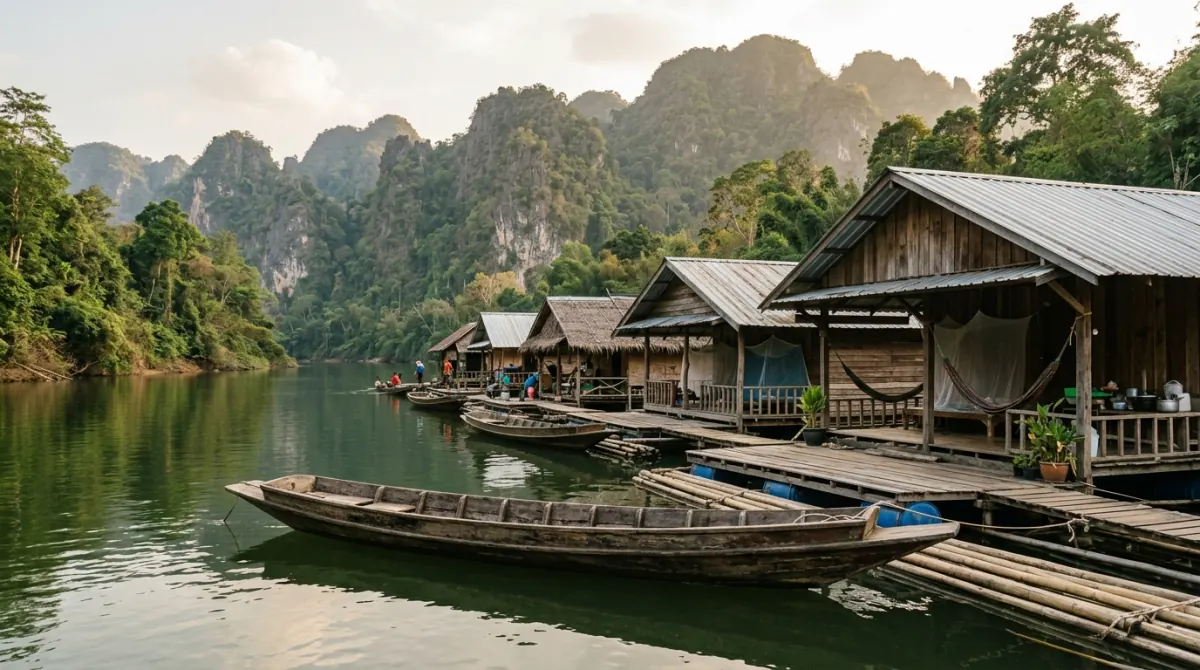
A River Kwai raft house is a bamboo room floating on the Kwai Noi in Sai Yok, reached by road or longtail boat, with no air conditioning, no wifi and no mains power after dark. On elephants the test is no riding, no shows, no scheduled bathing — no venue here was confirmed to pass, so skip them.
At a glance
| Raft house river | Kwai Noi, mainly Sai Yok district, roughly 60–100 km northwest of Kanchanaburi town |
| Typical access | Road to a pier, then 15–25 minutes by longtail boat; some raft houses are road-accessible |
| What the budget end means | No air conditioning, no wifi, no hot water, kerosene or generator light only after dark |
| Best water | Late November to February — full and clear, cool nights, low current |
| Elephants | No riding, no shows, no scheduled bathing. No venue in the province was confirmed to pass all three, so the recommended answer is to skip elephants here |
| Hindad Hot Springs | Highway 323, Thong Pha Phum, about 120–130 km north of town, roughly 2 hours' drive |
| Hindad hours and fee | Daily 06:00–22:00; roughly 40–60 THB for a foreign adult (sources disagree) |
| Mallika R.E. 124 | Sing sub-district, Sai Yok, about 32 km from town; around 250 THB (about USD 7.50) |
| Longtail boat hire at Sai Yok | About 400–500 THB per 30 minutes |
Raft houses on the Kwai Noi
The floating raft houses people book on the River Kwai are timber-and-bamboo rooms built on pontoons, moored in a line against the bank of the Kwai Noi. They are not boats and they do not go anywhere. Most sit in Sai Yok district, upstream of the town and the war sites, on a stretch where the river is wide, green and bordered by forested limestone hills rather than buildings.
The good ones are deliberately unplugged. River Kwai Jungle Rafts, the best-documented example and reachable only by longtail boat, states plainly that it "uses no conventional electricity at night" and lights its rooms and walkways with kerosene lamps instead. It has no air conditioning, no wifi and no hot water. That is the model, not a failure of the model. Rooms are around 28 square metres, built in Mon village style, and you sleep with the river running under the floor.
At the cheaper end the arrangement is similar but rougher: a fan running off a generator, a cold-water bathroom, a thin mattress and a mosquito net. No property publishes its generator hours. What operators report is a shutdown somewhere between 22:00 and 23:00, after which the fan stops and the room goes dark, so the hours are the first thing to ask before you book — the answer is the difference between a warm night and a still one. Two more questions belong in the same message: whether there is any hot water, and whether you arrive by road or by boat. The boat-access places are the quiet ones, and they also cost you half a day at each end.
Raft houses are booked either direct with the property — email, LINE or a Facebook page — or through the mainstream booking sites, where the larger resorts and the Sai Yok park accommodation are easiest to find. If a place you have seen photographed does not come up on the booking sites at all, look for its own page and write to it; small upriver operations are often not listed. Read the access wording before you pay: a listing that gives a pier, a meeting time and a transfer duration, or tells you to call when you reach the road, is a boat-access property, while a road-access one prints a street address and a map pin you can drive to. Room rates in town, and what each price band buys, are in Eating, Sleeping and What to Know Before You Go.
The party rafts are a completely different product sharing the same word. These are wide open-deck barges towed slowly along the river by a longtail, fitted with a sound system, and hired by Thai groups for a day or a night of eating, drinking and karaoke. They concentrate on the Kwai Yai above the town and on the Sri Nakarin reservoir rather than on the upper Kwai Noi, which is why the Sai Yok raft houses stay quiet. That split is what operators and repeat visitors describe rather than anything published, so treat it as the usual pattern and not a guarantee about any one mooring. The distinction on a booking site is easy to read once you know it: if the listing shows a big flat deck with speakers and no bedrooms, it is a cruise barge, not accommodation.
Inside Sai Yok National Park the park's own accommodation runs roughly 800–2,100 THB (about USD 24–64) a night depending on size, with a 20 percent discount Monday to Thursday, and camping at 30 THB per person with tents to hire at about 225 THB a day. The raft houses lining that stretch of river are private businesses, not park-run, so a national park ticket has nothing to do with them.
The elephant question has one answer, and no Kanchanaburi venue was confirmed to meet it
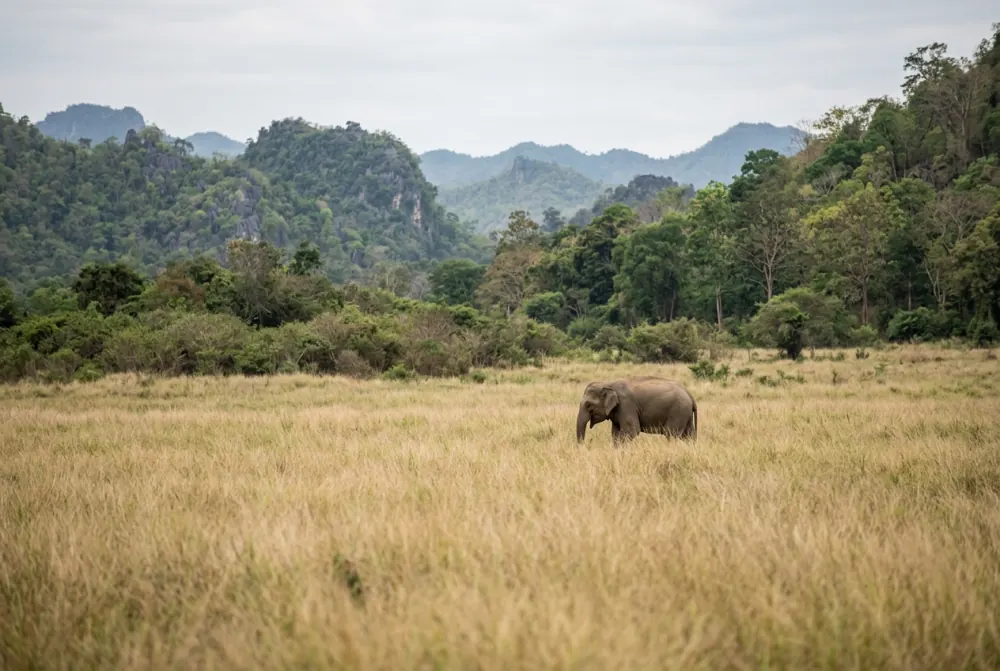
Do not ride an elephant. Do not bathe with one. Do not watch one paint, play football, or stand on its back legs. There is no version of those activities that is good for the animal, and every operator in Kanchanaburi selling them knows the market has moved and has renamed itself a sanctuary accordingly.
Riding and shows are the easy calls. Bathing is the one that trips up careful travellers, because it looks like the kind option. The problem is not water. Elephants bathe constantly on their own. The problem is a schedule: an elephant that enters the river when the 10:00 group arrives, again for the 13:00 group, and again for the 15:00 group is not bathing, it is working, and something has to make it stand still in the water among strangers. That something is a mahout with a tool and a lifetime of conditioning behind it. A sanctuary that has stopped using control on its elephants cannot promise you a bathing session at a fixed hour, which is exactly why the better operators in Thailand stopped selling them. Elephant Nature Park near Chiang Mai, the most-copied model in the country, ended tourist bathing in 2020, and other camps have followed.
Kanchanaburi has not followed. ElephantsWorld, near Wang Dong about 30 minutes outside town, is the province's best-known no-riding, no-show venue, and its own published programmes contain neither. But those same programmes — half day 1,800 THB adult and 1,300 THB child, full day 2,500 THB and 1,800 THB — still list a mud bath and, in its own words, a "River Bath with the Elephants". Scheduled bathing is the line drawn in the paragraph above, so on this chapter's own test ElephantsWorld fails, and the guide does not recommend it. It is a better day out than a riding camp and it is still an interaction product: book it only with that in front of you, knowing what you are buying. The recommendation for a first visit is to skip elephants in Kanchanaburi altogether and give the day to the waterfalls or the war sites instead.
What observation-only looks like. A large riverside or forested property where the herd chooses where it goes. Viewing from a raised walkway, a vehicle or a distance, with a guide explaining what you are seeing rather than handing you a bucket. Food preparation as the only hands-on activity, and even that at a distance from the animals. A hard daily cap on visitor numbers, published on the website. No photograph in which a visitor is touching an elephant. Chains used only for veterinary treatment or a specific overnight welfare reason, and the operator willing to explain exactly when and why.
Questions to ask before you pay. Ask them by email or LINE, and judge the willingness to answer as much as the answer.
- How many elephants do you have, and how many visitors do you take per day?
- Do you offer riding anywhere on the property, or through any partner camp?
- Is bathing on the daily schedule? How many bathing sessions run per day, per elephant?
- Are your elephants chained at any point in the day or night? When, and for what reason?
- Do your mahouts carry bullhooks or hooked sticks? Can I see photographs of your staff working?
- Do you own your elephants, or rent them from an owner?
- What do the elephants do on a day with no bookings?
That last question is the sharpest one. At a real sanctuary the answer is "the same thing they do every day". At a rental operation there is a pause before the answer.
Then read the visitor photographs. A competent bad operator answers all seven questions correctly by email. Visitor photographs are the one thing the venue does not write. Open its Google Maps and Tripadvisor listings, sort the visitor photos by newest, and work back through the last few months rather than through the operator's own gallery: look for saddle frames, chains around a foot or a leg, a hook or hooked stick in a mahout's hand, and visitors standing in the water in a line. A gallery where the newest visitor photograph is two years old tells you something as well.
Red flags, in the order you will encounter them. Riding platforms or wooden saddle frames anywhere on site, even stacked and unused. Elephants standing on short chains at a picket line while visitors queue. A stage, a painting easel, a football, or a printed show schedule. Bathing offered as an unlimited or repeated activity, or advertised as the headline attraction. Photographs on the operator's own site showing a hook in a mahout's hand. Coach parties. And a camp your resort books for you: ask at the desk whether the camp shares an owner, a manager or a shuttle with the hotel, and if the answer is yes, or is vague, put every question above to the camp itself rather than accepting the hotel's description of it. A resort with an elephant camp on the other end of the arrangement is selling the day, not vouching for it.
If a venue you contact will not answer those questions, or answers them and then contradicts itself in its own photographs, you have your answer. The day goes to the waterfalls or the war sites, and skipping elephants costs you nothing.
Book the kayak, skip the bamboo raft
Paddling the Kwai Noi is the best thing you can do on this river. The standard trip puts you in a two-person kayak upstream and lets you drift and paddle down past limestone cliffs, bamboo stands and the raft houses, usually for one to three hours. Most Sai Yok raft resorts run canoes for their own guests; independent operators in town run longer downstream sections and drive you back. There are no serious rapids on the tourist stretches — this is flatwater with a current, not whitewater.
Bamboo rafting is the other thing sold here, and it is much smaller than the name suggests. A poled bamboo platform holding six or eight people drifts a few hundred metres downstream while a boatman steers. It lasts perhaps twenty to thirty minutes. As a free inclusion at a raft house it is a pleasant half hour. As a paid standalone excursion it is not worth a special trip.
The third river activity costs nothing: raft house guests float downstream in a life vest, walk back up the bank, and do it again. On the Kwai Noi in the cool season this is the whole point of staying on the water.
Prices for kayaking and bamboo rafting could not be confirmed from any current source for this edition, and they vary widely between raft resorts and town operators, so treat any figure you are quoted as negotiable and confirm what is included before you pay.
Floating restaurants sell the deck, not the food
There are two things called a floating restaurant in Kanchanaburi and they are worth separating. The first is a moored platform — a covered deck on pontoons tied to the bank, at Sai Yok near the waterfall and the suspension bridge, and in a longer strip along the Kwai Yai near the bridge in town. You sit over the water, order from a standard Thai menu, and the river does the work. The food is competent and unremarkable; you are paying for the deck.
The second is a towed raft: a longtail boat pulls a floating deck slowly along the river for an hour or two while lunch is served. This is where the party rafts and the sedate lunch cruises overlap, so ask one question at the pier before you board — is there a sound system on this raft, and is another group sharing it. A shared barge with a karaoke rig is a different afternoon from a quiet drift, and both are sold with the same photographs.
At Sai Yok, longtail boat hire runs around 400–500 THB for 30 minutes, which is the practical way to see the waterfall from the water and to reach Lawa Cave from Pak Saeng pier. Lunch on a Sai Yok deck pairs naturally with a waterfall day; details of the falls themselves are in Erawan, Sai Yok and Kanchanaburi's Waterfalls.
Book lunch rather than dinner if the view matters. After dark you are looking at a black river and eating by strip light, and the towed rafts that operate at night are overwhelmingly the loud ones.
Three concrete pools, two hours north
Hindad (Hin Dat) Hot Springs sits on Highway 323 in Thong Pha Phum district, about 120–130 km north of Kanchanaburi town — roughly two hours' drive. It is run by the Hin Dat sub-district administration, not the national parks department, so no park ticket applies and you pay a small fee at the gate.
What you get is three open-air concrete pools of graded temperature under tall trees, plus a separate pool reserved for monks, with a cold mountain stream running alongside so bathers alternate hot and cold. There are changing rooms, lockers, toilets, massage and food stalls at the car park. The water is said to have been found by Japanese soldiers in 1943 during construction of the railway. It is a working local bathing place used by families from the surrounding villages, and dressing accordingly — shorts and a T-shirt rather than swimwear — will make your visit easier.
Two practical points. The published hours are daily 06:00–22:00, but the pools are drained and refilled on Mondays and Fridays at 15:00, so avoid mid-afternoon on those two days. And the entrance fee is unsettled: Thai-language sources give 40 THB for a foreign adult and 20 THB for a child, while several 2026 listings give 60 THB and 40 THB. No official Hin Dat sub-district page publishes it, so carry small notes and expect roughly 40–60 THB (about USD 1.20–1.80). The hours and the drain days above come from the same kind of listing, not from the office that runs the pools.
The distance is the deciding factor. Two hours each way for a 40-baht soak does not stand up as a round trip from Kanchanaburi town. It makes sense only if you are already driving north — to Thong Pha Phum, or on the way to Sangkhlaburi and the Mon Bridge, where Hindad is a natural leg-stretch roughly halfway up. Nothing on Highway 323 north of Sai Yok is served usefully by scheduled transport, so that combination is a driving day however you arrange it — talk to us if you would rather it was driven for you.
Mallika R.E. 124 is a theme park, and the first thing to cut
Mallika R.E. 124 recreates a Siamese town as it would have looked in R.S. 124 — 1905, in the reign of Rama V. It sits at Sing sub-district in Sai Yok, near Prasat Muang Singh, about 32 km and 40 minutes from Kanchanaburi town. Admission is around 250 THB. Inside, you exchange baht for the park's own token coinage to buy food and drink, staff work in period dress, costume rental is available, and the buildings, canals and market streets are well built.
It is a theme park, not a historical site. Nothing in it is original and nothing happened there. That is not a criticism of what it does — it does it carefully, and it is more popular with Thai visitors than with foreign ones, which is usually a good sign. But for a first-time visitor with two days in Kanchanaburi it competes directly with the Death Railway and the WWII sites and with the waterfalls, and it loses to both. English signage is thin, and reviewers consistently report missing whole sections because nothing tells you they are there. Go if you have a third day, if costume photography appeals, or if you are travelling with Thai family. Otherwise cut it.
Sources also disagree on closing time — the park's own Thai-language site says 09:00–17:00 while international listings say 09:00–18:00 — so do not plan to arrive after about 15:00 without calling first.
What else to skip. Any elephant camp offering rides, and any "sanctuary" that also sells them elsewhere on the property. The old Tiger Temple at Wat Pha Luang Ta Bua was raided and shut down by Thai wildlife authorities in 2016 and is not a visitable attraction; operators still advertising a "tiger temple" day trip from Kanchanaburi are selling you a captive tiger photo venue somewhere else, and it deserves the same answer as the elephant camps. Fish spas and pond-feeding platforms at raft houses are filler. Sunset dinner cruises on the Kwai Yai near the bridge are the noisiest boats on the river and the weakest food. And a boat-access raft house is the wrong choice for a one-night stay if you also want an early start at Erawan — the transfer at each end eats most of two mornings.