
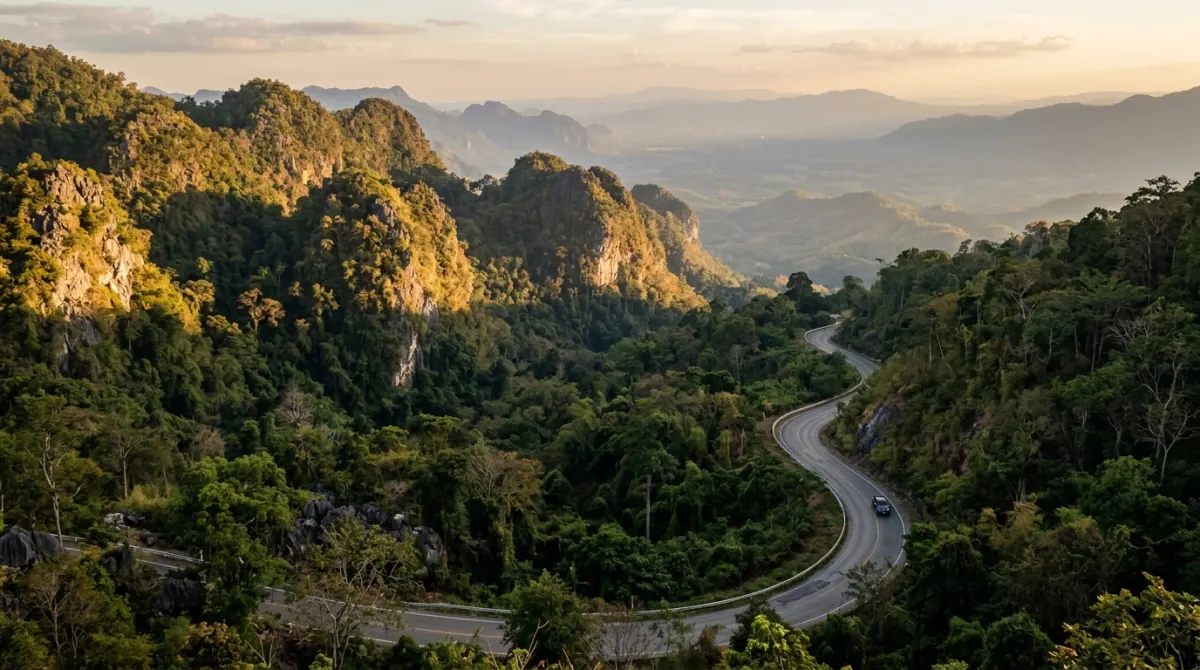
One day from Bangkok buys one zone and about 5h20 on the ground. Two days is the shape that works — the war sites and Hellfire Pass on one day, Erawan on the other. Three days adds the Sai Yok corridor and the Death Railway train, or an overnight in Sangkhlaburi.
At a glance
| One day from Bangkok, war sites | 11h55 door to door · 6h35 in the vehicle · about 5h20 at the sites |
| One day from Bangkok, Erawan | 13h00 door to door · 7h30 in the vehicle · about 5h30 at the falls and the bridge |
| Two days | One night in town. Hellfire Pass day, then Erawan day |
| Three days | Two nights in town. Adds the 06:02 train and the Sai Yok corridor as its own day |
| Three days, Sangkhlaburi version | Two nights, one of them in Sangkhlaburi. Not compatible with Erawan |
| Swimming at Erawan | Suspended park-wide on 16 September 2025 and no source confirms it has been lifted. Chapter 4 has the detail; plan a day that still works without the water |
| The hardest cut-off in the province | Erawan: gate 08:00–16:30, no entry after 15:30, and an earlier turnaround on the upper tiers |
| Second hardest | Hellfire Pass Interpretive Centre closes at 16:00 |
| Third | Thailand-Burma Railway Centre closes at 16:00; Kanchanaburi War Cemetery at 17:00 on weekdays and 12:00 on Saturday |
| Last minivan back to Bangkok | 19:00 · last through train 14:43 |
| Latest sensible departure from an outer zone | Before dusk. Route 3199 and Highway 323 are unlit outside the towns |
Entry fees are not repeated here. They sit in the Death Railway chapter and the waterfalls chapter, where the disputed ones are marked as disputed.
Every table below follows the same rule: the time in a row, plus that row's duration, plus that row's drive time, equals the time in the next row. Drive times are the padded figures from chapter 1, not routing-engine free-flow times.
One caveat that applies to all of them. Nobody has published door-to-door measurements for these routes. The Bangkok legs and the town-to-zone legs are separately sourced and reasonably firm; the links between outer sites — Hellfire Pass to Sai Yok Noi, Nam Tok to Hellfire Pass, Hindad to Sangkhlaburi — are worked out from distances plus driver experience, and they are the numbers most likely to be wrong by fifteen or twenty minutes. Every table is built with enough slack to absorb that, but if you are chasing a closing time, chase it with an hour in hand rather than ten minutes.
One day from Bangkok: 6h35 driving for 5h20 on the ground
Chapter 1 settles the principle: a day trip buys exactly one zone. What it does not do is show you the shape of the day, and the shape is where people lose the two hours that would have made it work. Two things do the damage. The first is a 07:00 or 08:00 departure from Bangkok, which is comfortable and which puts you at the bridge at the same moment as every coach on the road. The second is treating the return leg as whatever is left over, when it is a fixed two and a half hours that has to happen before the light goes.
Both versions below start earlier than feels reasonable and finish earlier than you expect. That is the trade a day trip is.
Version A — the war sites
This is the better one-day trip, and it is the one that survives March and April, when the falls run thin.
| Time | Activity | Duration | Drive |
|---|---|---|---|
| 06:00 | Leave a central Bangkok hotel | — | 2h30 |
| 08:30 | Bridge over the River Kwai, walked end to end before the coaches | 0h50 | 0h15 |
| 09:35 | Thailand-Burma Railway Centre | 1h15 | 0h05 |
| 10:55 | Kanchanaburi War Cemetery, directly across the road | 0h40 | 0h20 |
| 11:55 | Lunch — riverside strip, or a shophouse rice-and-curry tray in town | 1h05 | 0h20 |
| 13:20 | Chungkai War Cemetery | 0h40 | 0h20 |
| 14:20 | JEATH War Museum, or an hour by the river instead | 0h50 | 0h15 |
| 15:25 | Leave for Bangkok | — | 2h30 |
| 17:55 | Central Bangkok | — | — |
Three notes on that table. The 08:30 arrival at the bridge is the entire argument for the 06:00 start — chapter 3 puts the crowd there from about 10:00, so an hour and a half earlier is a different structure over a different river. The Railway Centre does not open until 09:00, which is why it comes second rather than first. And the 14:20 row is optional; the town's war sites are a morning and a bit, not a day, and if the museum does not appeal then leaving at 14:20 gets you back to Bangkok before the evening builds.
Version B — Erawan
| Time | Activity | Duration | Drive |
|---|---|---|---|
| 05:30 | Leave a central Bangkok hotel | — | 3h30 |
| 09:00 | Erawan gate: ticket, then the walk or shuttle up to tier 1 | 0h30 | — |
| 09:30 | Tiers 1 to 7 and back down to tier 2, swimming on the way if the pools are open | 3h30 | — |
| 13:00 | Lunch at the tier 1–2 stalls; reclaim the bottle deposit | 0h50 | 1h15 |
| 15:05 | Bridge over the River Kwai, on the way back through town | 0h40 | 0h15 |
| 16:00 | Leave for Bangkok | — | 2h30 |
| 18:30 | Central Bangkok | — | — |
Seven and a half hours in a vehicle for five and a half on the ground, most of that at one waterfall. It is defensible between late November and February, when the water is worth it, and it is a poor day in April.
The 15:05 bridge stop lands inside the 10:00 to 16:00 window chapter 3 identifies as the busiest, and a day trip cannot avoid it. The fixed point of this day is being off Route 3199 before dark, which means leaving the falls in the early afternoon, which puts you in town at exactly the hour the coaches are there. Take the bridge crowded, or drop the row and go straight home.
The cost you cannot buy off is the gate. Erawan opens at 08:00 and Bangkok is three and a half hours away, so the earliest realistic arrival is around 09:00 and you will be walking up with the first minibuses rather than ahead of them. Everything chapter 4 says about the first two hours belongs to people sleeping in Kanchanaburi, not to day-trippers. That is not a reason to skip the day trip. It is a reason to know that the two-day version of this day is a materially better day.
The bridge row is the only cross-zone move in either table, and it is free because the bridge is on the road you are already on. Do not extend that logic. Hellfire Pass sits on the other river and the other highway, and chapter 1 is clear about what pairing it with Erawan costs: about four and a half hours of driving in a day and a compressed visit at both ends.
What will not fit in a day from Bangkok?
The Sai Yok corridor, though not for the reason people assume. The clock does fit: leave Bangkok at 05:00, reach Hellfire Pass for its 09:00 opening, take the pass and Sai Yok Noi and a riverside lunch, start back at about 13:30 and be home by 17:15. What does not fit is everything else. That day costs seven and a half hours of driving to see one site and skips the bridge, both cemeteries and the Railway Centre entirely — and because the centre does not open until 09:00, the early start buys you nothing at the other end. It is the site chapter 3 says is worth building a day around, and building a day around it means sleeping in Kanchanaburi.
Sangkhlaburi, obviously — chapter 6 rules it out of a day trip and out of most two-day ones, and nothing about starting from Bangkok improves that.
Huay Mae Khamin, for the same arithmetic in a different valley.
Two days is the shape the province is built for
One night in Kanchanaburi town changes three separate things at once, and they compound. You get Hellfire Pass at 09:00 instead of at 12:30. You get Erawan's gate at 08:15 instead of 09:00, which is the difference between being above the coach crowd and being in it. And you get the bridge at the two hours it is worth seeing — late afternoon on day one, or first light on day two — rather than at the hour every day trip reaches it.
Sleep on the guesthouse strip in town, not upriver. A boat-access raft house on night one costs you most of two mornings in transfers, which is exactly the two mornings this plan needs; chapter 5 makes that point and it applies here with force. Chapter 7 covers where on the strip to sleep and what it costs.
Day 1 — Hellfire Pass and the war sites
Drive past the town on the way in. This is the counter-intuitive move that makes the two-day plan work: Hellfire Pass is 80 to 85 km beyond Kanchanaburi, and going straight there means you meet it at opening time in the cool of the morning, then work back down Highway 323 towards your bed rather than out and back from it.
| Time | Activity | Duration | Drive |
|---|---|---|---|
| 05:00 | Leave a central Bangkok hotel | — | 3h30 |
| 08:30 | Coffee at the Hellfire Pass car park; the centre opens at 09:00 | 0h30 | — |
| 09:00 | Hellfire Pass: Interpretive Centre, audio guide, and the walk into Konyu Cutting | 2h00 | 0h25 |
| 11:25 | Sai Yok Noi — twenty minutes, free, directly off the highway | 0h20 | 0h15 |
| 12:00 | Lunch on a riverside deck, and walk the Tham Krasae trestle | 1h15 | 0h50 |
| 14:05 | Thailand-Burma Railway Centre | 1h00 | 0h05 |
| 15:10 | Kanchanaburi War Cemetery | 0h35 | 0h15 |
| 16:00 | Bridge over the River Kwai, as the coaches leave | 0h45 | 0h15 |
| 17:00 | Check in on the guesthouse strip, shower | 1h30 | 0h10 |
| 18:40 | Night market beside the station | — | — |
The 05:00 departure is doing a specific job. Chapter 1 gives Bangkok to the Sai Yok corridor as three and a half to four hours, so a 05:30 start would be using the floor of that range with nothing in hand; leaving at 05:00 and spending the difference on coffee at the car park means a slow stretch of Highway 323 costs you nothing.
It is a long day: five and three-quarter hours of driving, most of it in the first block. The compromise in it is the 14:05 row. The Railway Centre closes at 16:00 and the cemetery at 17:00, so both get less time than they deserve on a day that also carries Hellfire Pass — and if the drive from Bangkok runs late, the Railway Centre is the row to drop rather than the one to rush. The three-day plan below fixes this by giving the town its own afternoon.
Sai Yok Noi earns its twenty minutes only because it is on the road. From about June to October there is real water coming over it; in March and April it is a wet rock, and on that trip you drive past it.
Day 2 — Erawan
| Time | Activity | Duration | Drive |
|---|---|---|---|
| 07:00 | Leave the guesthouse after breakfast | — | 1h15 |
| 08:15 | Erawan gate: ticket, then up the paved path to tier 2 | 0h45 | — |
| 09:00 | Tiers 3 to 7 and back down, swimming on the way if the pools are open | 3h30 | — |
| 12:30 | Lunch at the tier 1–2 stalls; reclaim the bottle deposit | 1h00 | 1h15 |
| 14:45 | Back in town: shower, an hour off the feet, collect bags | 1h30 | 0h15 |
| 16:30 | Leave for Bangkok | — | 2h30 |
| 19:00 | Central Bangkok | — | — |
Starting up at 09:00 puts you hours inside Erawan's upper-tier cut-off, which is the point of the early start and not a detail; chapter 4 sets out how unsettled the cut-off time is and why an itinerary that reaches tier 5 in mid-afternoon is gambling. This one never gets near it.
The 16:30 departure is the other fixed point. It is set by dusk on Route 3199 rather than by the falls, and chapter 7 explains why an unlit provincial road shared with slow trucks and dogs is the thing to plan around.
Give the Sai Yok corridor its own morning
Two days forces the Sai Yok corridor into the margins of a history day. Three days gives it a morning of its own, and it changes what the corridor is: instead of Hellfire Pass with a waterfall glimpsed from the car, you get the surviving railway ridden rather than looked at, then the pass, then the road back at your own speed.
There are two three-day plans, and they are mutually exclusive. The first stays in town and does the province properly. The second trades Erawan for Sangkhlaburi. Do not attempt both.
Version A — town, Erawan, Sai Yok
Day 1 — arrive, and give the town its own afternoon. The 08:00 departure here is deliberate. There is nothing to be gained by being at the bridge at 08:30 on a day when you will be back at it at 16:20, so this is the one morning of the trip you can leave Bangkok at a civilised hour.
| Time | Activity | Duration | Drive |
|---|---|---|---|
| 08:00 | Leave a central Bangkok hotel | — | 2h30 |
| 10:30 | Check in on the guesthouse strip, drop bags | 0h30 | 0h10 |
| 11:10 | Lunch — a rice-and-curry tray off Saeng Chuto Road | 0h50 | 0h10 |
| 12:10 | Thailand-Burma Railway Centre | 1h15 | 0h05 |
| 13:30 | Kanchanaburi War Cemetery, across the road | 0h40 | 0h20 |
| 14:30 | Chungkai War Cemetery | 0h40 | 0h20 |
| 15:30 | JEATH War Museum | 0h30 | 0h20 |
| 16:20 | Bridge over the River Kwai, as the coaches leave | 0h50 | 0h15 |
| 17:25 | Back to the guesthouse, shower | 0h55 | 0h10 |
| 18:30 | Night market beside the station | — | — |
Day 2 — Erawan, unhurried. This is the version of the falls day the two-day plan cannot give you: gate at 08:00, four and a quarter hours in the park, and an evening in town rather than a drive to Bangkok.
| Time | Activity | Duration | Drive |
|---|---|---|---|
| 06:45 | Leave the guesthouse | — | 1h15 |
| 08:00 | Erawan gate opens: ticket, then the paved path to tier 1 | 0h30 | — |
| 08:30 | Up to tier 7 and back down to tier 2 | 3h45 | — |
| 12:15 | Lunch at the stalls, a last swim if the pools are open, reclaim the bottle deposit | 1h00 | 1h15 |
| 14:30 | Back in town: shower and an hour off the feet | 1h30 | 0h15 |
| 16:15 | A drink on the riverside strip, or the bridge at dusk | 1h30 | 0h15 |
| 18:00 | Dinner — night market, or a floating deck | — | — |
Day 3 — the railway, then the pass. Chapter 3 notes that the 06:02 train reaches Nam Tok around 08:00 and that this lines up with Hellfire Pass opening at 09:00 if you can arrange the last 18 km. That is the day. You ride the surviving line in the best light it gets, over the Tham Krasae trestle at about 07:35, and meet the road again at the terminus.
| Time | Activity | Duration | Drive |
|---|---|---|---|
| 05:30 | Kanchanaburi railway station; buy the ticket at the counter | 0h32 | — |
| 06:02 | Train 485 to Nam Tok — the bridge, then the trestle at about 07:35 | 1h58 | 0h25 |
| 08:25 | Coffee at the Hellfire Pass car park; the centre opens at 09:00 | 0h35 | — |
| 09:00 | Interpretive Centre, audio guide, and the walk into Konyu Cutting | 2h15 | 0h25 |
| 11:40 | Sai Yok Noi | 0h20 | 0h15 |
| 12:15 | Lunch on a floating deck near Tham Krasae | 1h15 | 0h50 |
| 14:20 | Collect bags in town | 0h40 | 2h30 |
| 17:30 | Central Bangkok | — | — |
Two things govern that table. The 05:30 start is real and there is no later version of it — the next departure is 10:30, which reaches the trestle in flat overhead light and gets you to Hellfire Pass in the middle of the afternoon. And the whole day depends on something meeting you at Nam Tok, because the 18 km from the terminus to the pass has no useful scheduled service; without that, ride out and back and see Hellfire Pass on a different day.
The train times are the softest numbers in this chapter, and chapter 3 explains how firm they are and where they come from. That is why the 08:25 row is a coffee and not an activity: it is the slack that absorbs a late train without touching anything after it. Check the departure at the station ticket office the evening before, and if the train runs half an hour down, you still make the 09:00 opening.
Version B — the Sangkhlaburi three days
Chapter 6 is unambiguous: Sangkhlaburi is worth it overnight and not worth it as a day trip, it suits a third day rather than a second, and the entire case for it is being on the Mon Bridge at first light. That verdict sets the shape of this plan and also its cost — Erawan does not fit alongside it, and pretending otherwise would put six hours of mountain road and a waterfall day into the same 48 hours.
Day 1 is identical to Version A's Day 1 above. Days 2 and 3 are the trade.
Day 2 — north, breaking the drive. Highway 323 runs past Hellfire Pass and Hindad Hot Springs on its way to Sangkhlaburi, so the outbound leg absorbs both without a metre of extra distance. Put them on the way up, not the way back, when you will want to be moving.
| Time | Activity | Duration | Drive |
|---|---|---|---|
| 07:00 | Leave the guesthouse | — | 1h20 |
| 08:20 | Coffee at the Hellfire Pass car park; the centre opens at 09:00 | 0h40 | — |
| 09:00 | Interpretive Centre, audio guide, and the walk into Konyu Cutting | 2h00 | 0h55 |
| 11:55 | Hindad Hot Springs — soak, then lunch at the stalls | 1h20 | 2h00 |
| 15:15 | Check in at Sangkhlaburi | 1h15 | 0h10 |
| 16:40 | The Mon Bridge and Wang Kha in late afternoon | 1h20 | 0h15 |
| 18:15 | Dinner in Sangkhlaburi | — | — |
Day 3 — the hour you came for, then the drive back.
| Time | Activity | Duration | Drive |
|---|---|---|---|
| 05:30 | On the Mon Bridge for the dawn alms-giving | 1h00 | 0h10 |
| 06:40 | Sangkhlaburi morning market on the Thai side | 0h50 | 0h15 |
| 07:45 | Breakfast at the guesthouse, check out | 0h45 | 0h20 |
| 08:50 | Wat Wang Wiwekaram and the chedi, or the boat out to the sunken temple | 1h10 | 4h00 |
| 14:00 | Kanchanaburi town — late lunch | 1h00 | 2h30 |
| 17:30 | Central Bangkok | — | — |
Seven and a quarter hours of driving on day three is the price, and there is no way to reduce it. The 05:30 row is the reason the rest of the trip exists.
Two of the drive times in that day-two table are softer than they look. The Hellfire Pass to Hindad leg and the Hindad to Sangkhlaburi leg are both worked out from the distances in earlier chapters rather than measured, and the second of them covers the mountain section past Thong Pha Phum, where an hour can disappear behind a slow truck. Treat 15:15 as the earliest you might check in rather than the time you will.
Themed variants change the turn-around point, not the route
The province only has two roads out of town, so a themed trip is not a different itinerary. It is the same skeleton with a different decision about how far up it you go and when you turn round.
History-focused
Two changes to the plans above. First, take the long trail at Hellfire Pass — about three hours return along the original rail bed past the Hintok station site, Hammer and Tap Cutting and the Pack of Cards Bridge, rather than the 40 to 45 minutes down into Konyu Cutting. Second, give the Railway Centre a proper hour and a half rather than the compressed hour the two-day plan allows. Both need Hellfire Pass to have a day, which means a two-day trip at minimum and preferably three.
One thing to carry through the day: every site on this itinerary commemorates the Allied dead. Between 12,000 and 13,000 Allied prisoners died on the railway and 75,000 to 90,000 Asian labourers did, and the larger toll has no cemetery, register or memorial anywhere in the province — chapter 3 sets out who they were.
| Time | Activity | Duration | Drive |
|---|---|---|---|
| 06:30 | Leave the guesthouse | — | 1h20 |
| 07:50 | Coffee at the Hellfire Pass car park; the centre opens at 09:00 | 1h10 | — |
| 09:00 | Interpretive Centre and the audio guide, without hurrying | 1h00 | — |
| 10:00 | The long trail out to Compressor Cutting and back | 3h00 | 0h25 |
| 13:25 | Sai Yok Noi, then a late lunch on a riverside deck | 1h30 | 1h00 |
| 15:55 | Chungkai War Cemetery | 0h40 | 0h20 |
| 16:55 | Back to the guesthouse strip | — | — |
If the trip falls in May, check the closure dates first. The centre and both trails shut completely for about three weeks every May for maintenance — chapter 3 has the entry details and the closure — and that takes the whole of this variant with it.
Family with children
Three inherited rules do most of the work here. No elephant riding, no shows and no bathing sessions, which chapter 5 sets out in full and which rules out most of what is marketed to families in this province. No Sangkhlaburi — 220 km of mountain bends each way is the wrong road for small children. And no attempt on Erawan's upper tiers: tier 4 is where the rock slide and the best pools are, the crowd has thinned by then, and above it the concrete gives up and the climb becomes wet rock and tree roots.
| Time | Activity | Duration | Drive |
|---|---|---|---|
| 07:15 | Leave the guesthouse after breakfast | — | 1h15 |
| 08:30 | Erawan gate: tickets, life jackets if the pools are open, and the shuttle up to tier 1 | 0h40 | — |
| 09:10 | Tiers 1 to 4 — the limestone slide at tier 4 if the water is open, the pools and the boardwalk if it is not | 2h20 | — |
| 11:30 | Back down to tier 2: the deep pool, the fish in the shallows, and shade to sit in | 1h00 | — |
| 12:30 | Lunch at the stalls; reclaim the bottle deposit | 1h00 | 1h15 |
| 14:45 | Back in town: pool, or a nap through the worst of the heat | 2h00 | 0h15 |
| 17:00 | Bridge over the River Kwai, then the night market for dinner | — | — |
Tell children about the tier 2 fish before they get in rather than while they are standing in the water: they are hand-sized mahseer barbs that arrive within a minute and bump hard, and chapter 4 describes what that is like.
For the history day with children, keep the town version and drop Hellfire Pass. The audio guide at the pass is built around survivors describing men dying, the trail is hot and exposed, and there is no version of that afternoon that works for a six-year-old. The bridge, the Railway Centre and the train ride do work.
Nature and hiking
This is the one theme that needs three days, because the two things worth doing are on different rivers and neither is a half day.
Day one is Erawan done properly: gate at 08:00, all seven tiers, the last pitch to tier 7 being roughly 200 steps of hands-on climbing, and back down at your own speed. Day two is the water rather than the falls — a morning kayaking the Kwai Noi, which chapter 5 rates as the best thing you can do on this river, and a night at a raft house upriver. Put that night after Erawan rather than before it; a boat-access raft house on the night before a waterfall day eats the morning you needed.
Day three continues up the arm you are already on rather than crossing the province: Sai Yok Yai in the morning, Lawa Cave by longtail from Pak Saeng pier, and Hellfire Pass on the way back down Highway 323. One river, one road, and you start it from wherever you slept rather than from town. Chapter 1 is the reason this matters: the Kwai Yai and Kwai Noi roads split at the town and never rejoin, so anything on the other arm means driving back down first. Pick two of the three — chapter 4 is right that a day already carrying Hellfire Pass and a waterfall should drop the cave, and the boat is 45 minutes each way before you are underground.
Which is what makes Huay Mae Khamin a day of its own and not a day three. It sits up the Kwai Yai arm past the Srinagarind dam, and doing it means starting from town before 07:00, not from a raft house upriver on the wrong river. Chapter 4 is direct about the trade: quieter than Erawan rather than better, comparable water, and a last 45 km of single-lane reservoir road with blind bends and steep pitches that turns into two and a half to three hours each way. Take it as a fourth day, or in place of the Erawan day if you have already seen Erawan and want the emptier version — and only with a vehicle, a whole day, and water in the system, which means not March, not April, and not in a low year.
The rows no bus timetable can fill
Every table in this chapter has a row that scheduled transport cannot fill. The 08:15 arrival at Erawan is before the first bus of the day gets there; the 16:30 departure from the park is after the last one leaves. Nam Tok station to Hellfire Pass has no useful service at all, which is the single link the three-day railway morning depends on. Hindad Hot Springs, Huay Mae Khamin and most of the raft-house piers have nothing scheduled reaching them. And the two-day plan's opening move — driving past the town to be at Hellfire Pass when it opens, then working back down the highway — is not something a bus timetable will let you do in that order. What a car buys, in every one of those cases, is the two or three hours a day that waiting and connecting would otherwise take, plus the ability to leave a place when you are finished with it rather than when the last vehicle goes. It does not make a day trip into a two-day trip, and it does not make Sangkhlaburi a day trip. Transfer fares are on the booking page, and chapter 2 explains how full-day and multi-day charters are priced differently from point-to-point runs.